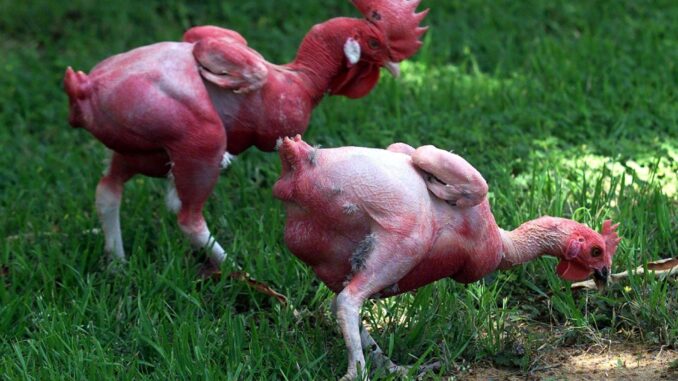
If you have seen pictures online of bare-skinned chickens from Israel and claims about GMO birds laying cancer drugs, you are looking at two different stories mixed together. Some of it is real science.
The bare-skinned chicken developed by geneticist Avigdor Cahaner at the Hebrew University of Jerusalem was not created with genetic engineering.
How it was done: It came from selective breeding. Researchers took standard broiler chickens and crossed them with a natural mutant breed that already carried the naked neck gene. That gene reduces feather coverage around the neck and body.
Israel and other hot countries spend a lot on cooling poultry houses. Featherless birds lose heat more easily. That means they can survive and grow better in tropical and desert climates without as much air conditioning or energy use. It was designed as a low-cost solution for farmers in hot regions, not as a lab experiment.
Because no foreign DNA was inserted, scientists do not classify these birds as genetically modified organisms.
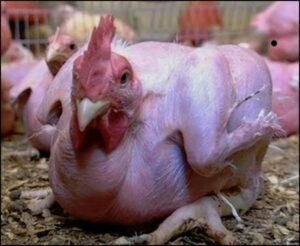
The chickens you see in supermarkets that reach market weight in about 6 weeks, and hens that lay over 300 eggs a year, are not GMO.
That speed comes from decades of selective breeding, better nutrition, and improved housing and health care. Breeders picked the fastest-growing birds each generation and bred them together. Nutritionists developed feeds that convert efficiently into meat and eggs.
As of today, no genetically modified chickens are sold for food in supermarkets anywhere in the world. Regulations, consumer demand, and the cost of approval have kept GMO chickens out of the food supply.
So the big breast, fast growth, and high egg numbers are about breeding and farming science, not gene editing.
Scientists really have made chickens that lay eggs containing human medical proteins. But the most famous work did not happen in Israel.
The pioneering research was done at the Roslin Institute in Edinburgh, Scotland. This is the same institute that cloned Dolly the sheep.
Researchers inserted human genes into chicken DNA so the birds would produce therapeutic proteins in their egg whites. One example is IFNalpha2a, a protein with antiviral and anti-cancer properties. The chicken’s body does the work of making the drug, and it ends up in the egg white.
Making protein drugs in chicken eggs can be up to 100 times cheaper than making them in traditional lab bioreactors. That could make treatments for cancer, arthritis, and other diseases much more affordable. The eggs themselves are not for eating. They are used as a pharmaceutical factory.
The featherless Israeli chicken exists, but it was bred, not genetically engineered.
The super-fast broiler chicken exists, but it was also bred. The drug-making chicken exists, but it was made in Scotland for medicine, not for food.
No one is currently selling GMO chicken meat or eggs at your local market.
These stories show how science can solve different problems. Breeding helps farmers deal with heat and food costs. Genetic engineering in research labs helps make medicine cheaper. Both are important, but they are not the same thing.
Next time you see a photo of a bare chicken from Israel with a headline about GMO, you will know the truth. It is a selectively bred bird built for the desert, not a lab creation. And the chickens that may one day help make cancer drugs are working in a lab in Scotland, not on a farm in Israel…See_More









Leave a Reply