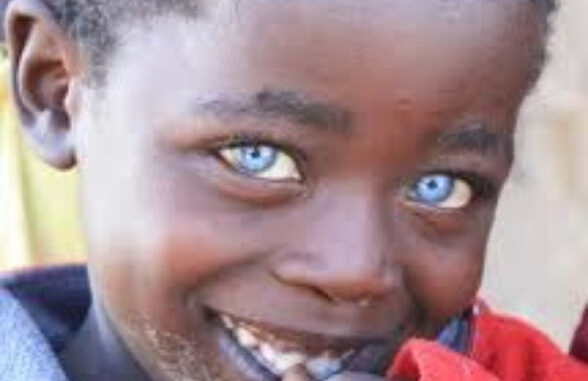
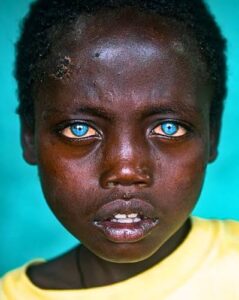
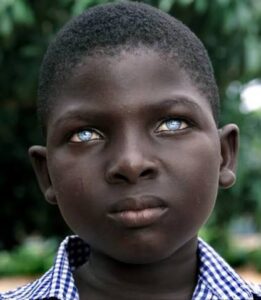
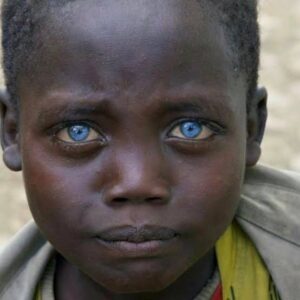
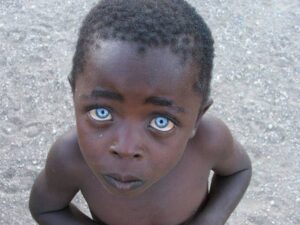
In the remote village of Konamu, tucked into the Labrade region of Adamawa State, Nigeria, children with striking natural blue eyes play in the dusty streets. What makes it remarkable is this: none of them have foreign ancestry.
For generations, Konamu has been known for its unusually high concentration of blue-eyed residents, especially among children. In a country where brown and dark eyes are the norm, the village stands out as a living genetic puzzle.
Globally, scientists trace all blue eyes back to a single genetic mutation that occurred in a common ancestor thousands of years ago. That mutation reduced melanin production in the iris, creating the blue color.
So how did it appear so strongly in Konamu, a community with no known European or mixed heritage? Experts say the answer likely lies in isolated, local genetics.
Researchers point to two main possibilities for the phenomenon in hyper-specific communities like Konamu.
1. Spontaneous Genetic Mutation.
A rare, recessive mutation can stop the iris from producing melanin. In an isolated village where families have intermarried within the same community for centuries, that rare trait can become more common. Over generations, children born to two carriers have a higher chance of expressing the blue-eye gene, even without outside ancestry.
2. Waardenburg Syndrome.
Many similar global communities with blue eyes, unusual hair streaks, or lighter skin carry Waardenburg Syndrome. It is a genetic condition that affects pigment development. In its milder forms, the most visible sign can be vivid blue eyes, sometimes with a white forelock or differences in hearing.
Local health workers say they have not confirmed any hearing or hair differences in Konamu, but without formal genetic screening, Waardenburg Syndrome cannot be ruled out.
Villagers describe the blue eyes as normal to them. “We have always had them,” said a community elder. “Our grandparents had them, their grandparents had them. It is just how we are born.”
Children with blue eyes often attract visitors and researchers who travel to Labrade to see the village for themselves. For the people of Konamu, it is both a point of pride and a source of constant questions from outsiders.
Geneticists say only DNA testing can confirm the exact cause. Until then, Konamu remains one of Nigeria’s most fascinating genetic case studies. A remote village where a single ancient mutation, passed down in isolation, painted the eyes of its children blue…See More







Leave a Reply