

For many Christians, the life of Jesus is well known from birth in Bethlehem to ministry in Galilee, crucifixion in Jerusalem, and resurrection. But between the account of a 12-year-old Jesus in the temple and his baptism around age 30, the Gospels are silent. That 18-year gap has fueled centuries of speculation. One of the most persistent theories today points to Africa, specifically to Ethiopia, and to a Bible that most Western churches do not use.
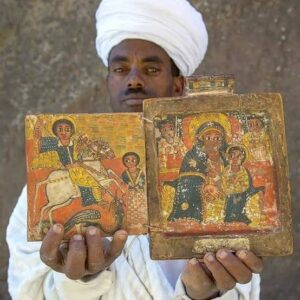
The Ethiopian Orthodox Tewahedo Church is one of the oldest Christian communities in the world. It adopted Christianity in the 4th century and developed in relative isolation from Rome and later European centers. As a result, it preserved a canon of 81 books, compared to the 66 books in the Protestant Bible and the 73 in the Catholic Bible.
That broader canon includes texts such as the Book of Enoch, the Book of Jubilees, and the Ascension of Isaiah. These works were known in early Judaism and early Christianity. They discuss angels, the origins of evil, calendars, and covenant history. They were quoted by early writers but were not included when the Western canon was finalized. In Ethiopia they were copied, read in liturgy, and treated as scripture.
Because of this, Ethiopian tradition contains stories, interpretations, and historical claims that never entered European theological education. To many outside observers it looks like a “forbidden” Bible. To Ethiopians it is simply the Bible they have always had.
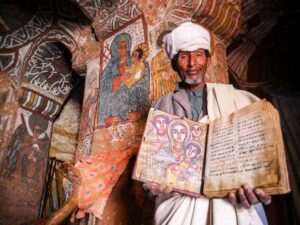
The theory gaining traction online argues that Jesus spent part of his missing years in Ethiopia studying with priests and sages. Proponents point to several threads. First, Ethiopia had ancient centers of learning and monastic life. Second, trade routes connected the Levant to the Horn of Africa, making travel plausible. Third, Ethiopian tradition itself claims a deep continuity with biblical Israel through the story of the Queen of Sheba and King Solomon.
The Kebra Nagast, or Glory of Kings, is central here. Written down in the 14th century but based on much older oral tradition, it recounts how Menelik I, son of Solomon and the Queen of Sheba, brought the Ark of the Covenant to Axum. According to the text, the Ark remains in Axum today, guarded by priests. For believers, this places Ethiopia at the heart of the covenant, not on the margins.
From this foundation, some argue that it is reasonable Jesus would have traveled to a place that already saw itself as part of biblical history. They suggest he absorbed wisdom traditions that later shaped his teachings on justice, the kingdom, and the spirit.
Mainstream biblical scholars do not accept that Jesus lived in Ethiopia. The Gospels give no record of such travel, and there are no first-century Ethiopian texts that name Jesus. Most historians read the silent years as a period of ordinary life in Nazareth, working as a carpenter in a Jewish village under Roman rule.
What scholars do acknowledge is that Ethiopia preserved early Christian literature that the West lost. The inclusion of Enoch and Jubilees matters because those books influenced the New Testament writers. Jude directly quotes Enoch. Ideas about watchers, judgment, and messianic expectation found in those texts help explain the world Jesus and the apostles lived in.
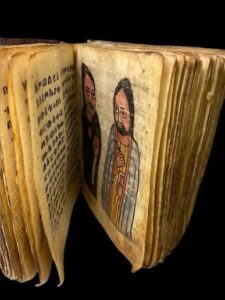
Ethiopia’s importance is not that it proves a secret journey. Its importance is that it shows Christianity was never only a European story. By the 4th century, the kingdom of Aksum was Christian. It had its own language, Ge’ez, its own church structure, and its own biblical manuscripts. Because it was outside the Roman Empire, it did not follow every council decision or canonical list made in Europe.
That independence allowed Ethiopia to keep practices and books that elsewhere were set aside. It also meant Ethiopian Christians developed theology, art, and law with less outside interference.
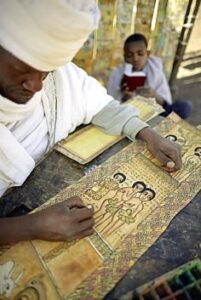
The conversation about a forbidden Ethiopian Bible is really a conversation about memory. Which books were kept, which were set aside, and who decided. When people encounter the 81-book canon for the first time, it challenges the assumption that the Western Bible is the complete and original list.
The missing years theory may remain speculation. But the larger point stands. Ethiopia preserved a version of Christianity that predates much of European influence. It kept texts, traditions, and claims, including the presence of the Ark in Axum, that force a rethinking of where the center of biblical history lies.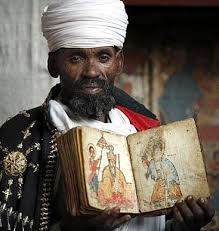
Whether one believes Jesus walked the highlands of Ethiopia or not, the Ethiopian Orthodox tradition offers something valuable: evidence that the Christian story was wider, older, and more diverse than many were taught. And in that sense, Ethiopia is not a footnote. It is a foundation…See_More




Leave a Reply