
Most people grow up thinking Africa had no writing before Europeans arrived. Nsibidi proves that wrong. It is an ancient system from southeastern Nigeria and parts of Cameroon, and for centuries it was used to record law, spirituality, and everyday life. Colonial authorities worked to suppress it because it showed a level of organization they claimed did not exist.
Nsibidi is estimated to date back to between 400 and 1400 CE. It is not an alphabet. It is semasiographic, which means symbols represent whole ideas, words, or concepts instead of individual sounds.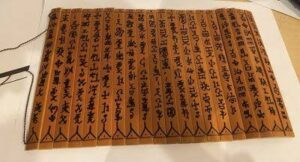
It developed among groups including the Ejagham, Igbo, and Efik. Because it is not tied to one spoken language, people who spoke different languages could use it to communicate.
The system worked on two levels. The public layer was used for things everyone could read. Love messages, warnings, proverbs, and signs on textiles or walls. The sacred layer was restricted to initiated members of societies like Ekpe, also called Leopard Society. That layer recorded oaths, judgments, spiritual knowledge, and political agreements.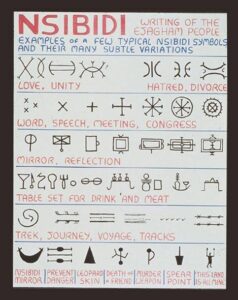
Nsibidi is different from Western writing in three key ways.
First, it is logographic. One symbol can mean justice, danger, wealth, or peace. Context and combinations build complex meaning.
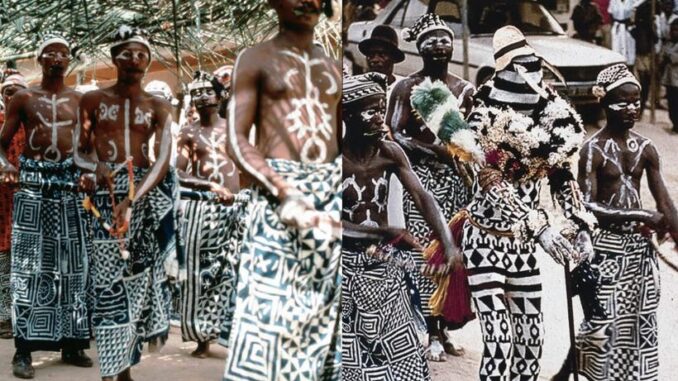
It is three-dimensional. Nsibidi was not only drawn on wood, skin, calabash, and cloth. It was also performed through hand gestures, tattoos, body scarification, and the movements of masquerades. A symbol on cloth and a gesture in a meeting could mean the same thing.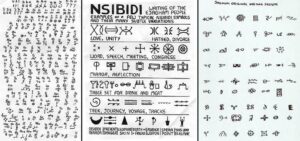
It was legal. Communities used Nsibidi to record court cases, mark property boundaries, register marriages, and enforce community laws. Elders could leave a symbol on a farm or path and everyone understood the rule attached to it.
Why Colonial Authorities Targeted It
European colonizers promoted the idea that Africa was without writing, law, or history. Nsibidi contradicted that. A functioning legal script meant societies had governance, contracts, and record-keeping long before colonization.
To weaken local authority, colonial administrators banned secret societies, confiscated objects with Nsibidi, and punished its use. Because the highest level of the script was tied to Ekpe, attacking the society also attacked the transmission of the script. Over a few generations, knowledge that was once common became hidden.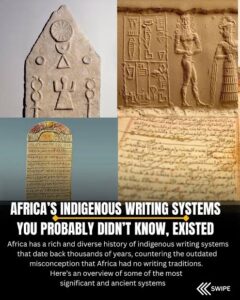
Survival Through the Diaspora
Nsibidi did not disappear completely. It traveled with enslaved Africans to the Caribbean and the Americas. In Cuba and Haiti, elements of Nsibidi appear in Abakuá society symbols, tattoos, and art. In the American South, similar markings showed up in quilts, pottery, and spiritual practices.
In Nigeria and Cameroon, elders kept it alive in secret, passing it to initiates even when it was dangerous to do so.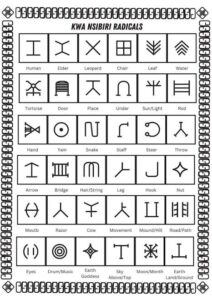
Nsibidi was not the only African writing system. Others also show a deep literate history.
Ge’ez from Ethiopia and Eritrea is an abugida still used today for Amharic and Tigrinya religious and state texts.
Vai from Liberia and Sierra Leone is a syllabary used for trade letters and records, now with digital fonts.
Bamum from Cameroon began as pictographs and evolved into a syllabary used by the royal court for history and maps.
Ajami across West Africa adapts Arabic script to write local languages for Islamic scholarship and poetry.
Together they show that African literacy was diverse, not absent.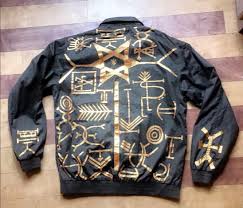
Today Nsibidi is being reclaimed. Linguists are cataloging symbols. Digital typographers are creating fonts so the script can be typed on phones and computers. Artists use it in fashion, murals, album covers, and architecture to connect modern African identity to pre-colonial knowledge.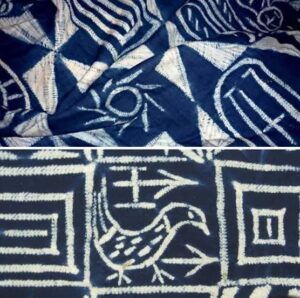
This is not just about aesthetics. It is about cognitive liberty, the right to use your own system of meaning without it being erased. 
Nsibidi reminds us that writing is not only letters on paper. It can be a symbol on cloth, a mark on skin, a gesture in court. Europe tried to erase it because it proved Africa was already organized, literate, and self-governing. The fact that it survived means that story could not be erased completely…See_More




Leave a Reply