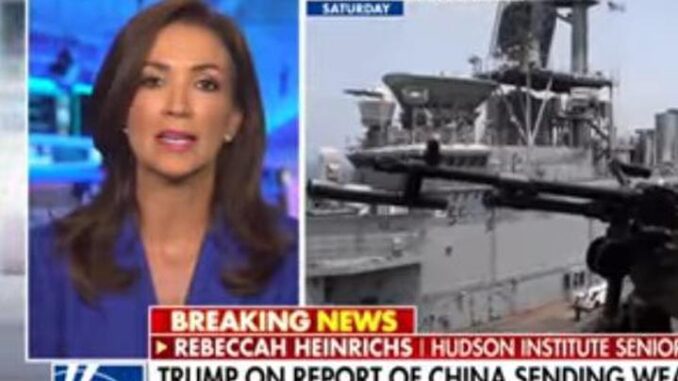
According to Fox TV on Thursday, July 30, 2026, Hudson Institute senior fellow Rebeccah Heinrichs cautioned that any direct Chinese support for Iran amid the ongoing conflict in the Middle East would mark a significant escalation with far-reaching geopolitical consequences. She urged the United States to respond decisively if credible evidence confirms Beijing’s involvement.
Speaking during an interview on Fox TV, Heinrichs said reports suggesting that China could be providing assistance to Iran should be taken seriously, warning that such a development would deepen regional instability and further complicate an already tense international security environment. She argued that any direct intervention by Beijing would signal a dangerous expansion of the conflict beyond the immediate parties involved.
According to Heinrichs, “During the heat of this war right now, this would be a major escalation on the part of the Chinese to get engaged in this. If we have any indication the Chinese are doing that, it is important for the President to name and shame what the Chinese are doing.”
She maintained that the United States should not remain silent if there is credible intelligence indicating Chinese assistance to Iran. Instead, she called on the U.S. administration to publicly expose any such actions and hold Beijing accountable through diplomatic and strategic measures, arguing that transparency would help rally international support and deter further escalation.
Heinrichs also suggested that conflicts taking place in different parts of the world are becoming increasingly interconnected, making it more difficult for major powers to treat them as isolated crises. She pointed to what she described as growing links between developments in the Middle East and the war in Eastern Europe, arguing that the strategic interests of major global powers are becoming more intertwined.
Highlighting this broader trend, she said, “The wars in different geographic areas are converging. The Russians were shipping weapons to the Iranians as well, and Ukrainians took out that ship. So these areas are converging, and the United States has to have a plan to deal with it.”
The Hudson Institute fellow stressed that Washington must adopt a comprehensive strategy capable of addressing multiple interconnected security challenges simultaneously. She argued that evolving alliances and military cooperation among countries such as Russia, Iran, and potentially China require a coordinated response from the United States and its allies. According to Heinrichs, failure to anticipate these shifting geopolitical dynamics could make future conflicts more difficult to contain and increase the risk of broader international instability…See_More





Leave a Reply