China’s Defense Minister Admiral Dong Jun has stated that Beijing will honour its trade and energy deals with Iran and that Chinese ships will continue navigating the Strait of Hormuz despite regional tensions, the ongoing US-Iran conflict, and President Trump’s order for a naval blockade of Iranian ports starting April 13.
The statement, made publicly and reported across international outlets, is a direct assertion of China’s economic interests and a clear signal that Beijing will not comply with American attempts to isolate Iran or control who uses the Strait of Hormuz.
Approximately forty percent of China’s oil imports pass through the waterway, making it a strategic chokepoint that China cannot afford to abandon or allow the United States to militarise in ways that threaten Chinese access to energy supplies.
The declaration is significant because it places China on a collision course with US policy. Trump’s blockade order applies to all maritime traffic to and from Iranian ports, meaning that Chinese vessels carrying oil, goods, or equipment to or from Iran would be subject to interception, boarding, or seizure by US naval forces.
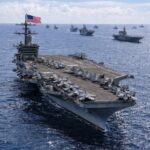
Admiral Dong’s statement that Chinese ships will continue navigating the Strait is a refusal to accept those terms and a warning that any attempt to stop Chinese vessels will be met with resistance, potentially involving the Chinese navy, which has been expanding its presence in the region and has the capacity to escort commercial ships and defend them against interference.
China is Iran’s largest trading partner and biggest oil customer, a relationship that has deepened as Western sanctions have pushed Iran toward closer ties with Beijing and Moscow. Chinese companies buy Iranian crude at discounted prices, provide technology and investment for Iranian infrastructure projects, and supply goods that Iran can no longer source from Western markets. The relationship is mutually beneficial. Iran gets a reliable buyer and a source of foreign exchange that is not subject to US sanctions. China gets affordable energy and a geopolitical partner that shares its interest in challenging American dominance and building a multipolar world order.
The US blockade threatens that relationship, and China’s response makes clear that it will not allow American military power to dictate who it trades with or where its ships can go. The Strait of Hormuz is an international waterway, and under the principle of freedom of navigation, ships from any nation have the right to transit it without interference. The US blockade violates that principle, at least from China’s perspective, and Beijing’s refusal to comply is a defence of international law and a challenge to American unilateralism.
The forty percent figure is critical. If China loses access to the Strait or is forced to reroute oil shipments through longer and more expensive alternative routes, the economic impact would be substantial. Energy prices would rise, supply chains would be disrupted, and China’s industrial capacity would face constraints that would ripple through the global economy. Beijing cannot afford to let the US control or close the Strait without pushing back, and Admiral Dong’s statement is the first public indication of what that pushback will look like….See More



Leave a Reply