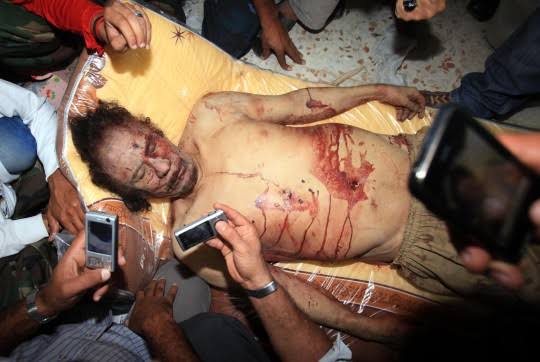
For 42 years Muammar Gaddafi shaped Libya and tried to shape Africa. He came to power in 1969 as a young officer promising to end foreign control, redistribute oil wealth, and build a new model of government. By the time he was killed in 2011, his name had become a symbol both of defiance and of excess.
In classrooms the story is often reduced to sanctions, protests, and war. The domestic and Pan-African projects he pursued are rarely explained in full, or with their contradictions.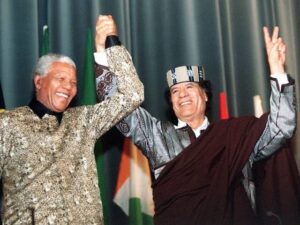
When Gaddafi took control, oil was already Libya’s main resource, but foreign companies set the terms. His government renegotiated contracts, cut production quotas, and raised taxes before moving to nationalize the industry. The revenue that followed paid for roads, hospitals, schools, and public housing on a scale Libya had never seen. At independence most Libyans lived in poverty.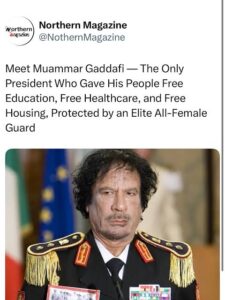
By the 1980s literacy had risen sharply and basic healthcare was widely available. The state also launched large housing programs meant to guarantee shelter as a right, not a commodity.
That model came with a cost. The economy became almost entirely dependent on oil, and decisions about spending ran through the state. Critics argue that distribution favored regions and tribes close to the regime, while areas like Benghazi in the east felt neglected.
The Green Book, Gaddafi’s political manifesto, also rejected private property and private enterprise. Without competition or independent institutions, corruption grew and the quality of public services declined in later decades.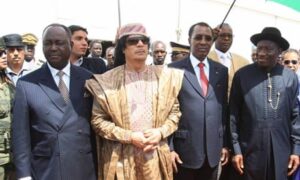
Perhaps the most ambitious domestic project was the Great Man-Made River. Libya sits over the Nubian Sandstone Aquifer, a vast underground reserve of fossil water.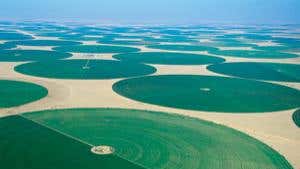
Gaddafi’s government built pipelines to carry that water hundreds of kilometers to the coastal cities where most people live. It was one of the largest engineering works in history and it solved an immediate problem of drinking water and irrigation.
Scientists warned, however, that fossil water does not replenish. The project bought time for Libya, but it did not create a permanent solution.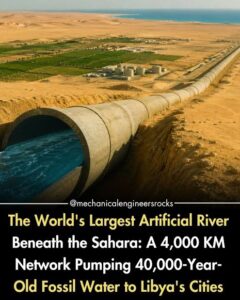
On the continent, Gaddafi presented himself as a Pan-Africanist. He provided funding in the early years of the African Union and bankrolled RASCOM, Africa’s first independent communications satellite. Before RASCOM, African countries often routed calls through Europe at high cost.
He also campaigned for a gold-backed African currency, a dinar that would bypass the US Dollar and the French CFA franc. The idea appealed to leaders who wanted monetary independence, even as Western powers opposed it.
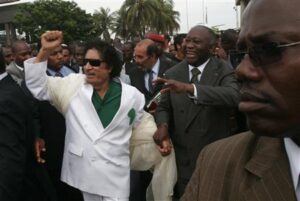
That same Pan-African posture was inconsistent. Libya gave money and arms to liberation movements fighting colonialism and apartheid in Southern Africa, which earned Gaddafi respect in many capitals. At other times it supported rebel groups in Chad, Sierra Leone, and elsewhere, drawing accusations of destabilization. Sanctions and isolation followed allegations of state-sponsored terrorism, and for years Libya was cut off from much of the global economy.
On social issues, the record is also mixed. The state outlawed forced marriage, expanded girls’ education, and created the Revolutionary Nuns, an all-female military unit.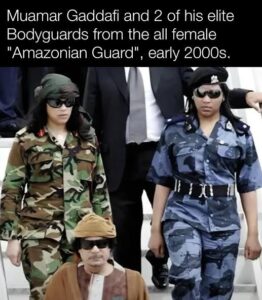
Women entered universities and the professions in far greater numbers than before 1969. Yet independent women’s organizations and political opposition were not permitted. Advocacy was tolerated only when it fit the official line, which meant progress happened inside strict limits.
Gaddafi’s governing philosophy rejected political parties and parliaments. He promoted people’s committees and direct participation as an alternative to Western democracy. In practice, power remained centralized. Without checks, debate was managed from the top, and dissent was not protected.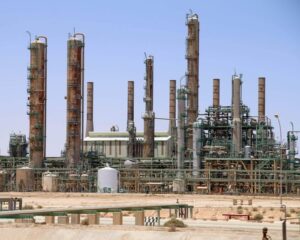
The result is a legacy that does not fit neatly. He used oil wealth to build infrastructure and expand access to education and health. He pushed African unity, communications, and financial independence at a time when few did. He also centralized power, restricted freedoms, and left Libya dependent on a single resource and a finite water supply.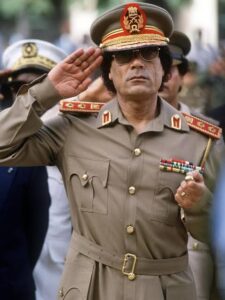
That is why many still call him Africa’s last hope, and why others call him a caution. Schools often teach the conflict, not the context. Understanding both the projects and the trade-offs is the only way to see why his name still sparks such strong reaction across the continent today…See_More
Leave a Reply