
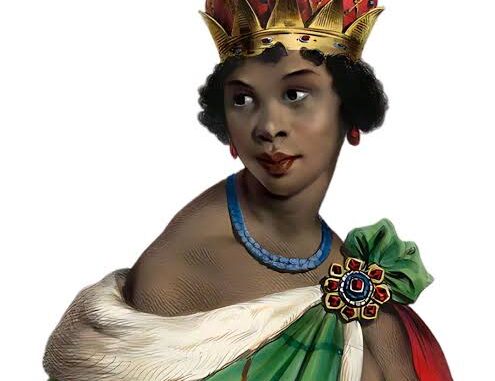
Queen Nzinga Mbande of Ndongo and Matamba remains one of Africa’s most formidable resistance leaders. In the 17th century, at a time when Portuguese colonization and the transatlantic slave trade were tearing Central Africa apart, she spent nearly four decades defending her people’s sovereignty.
Her story is rarely taught in standard school curricula, but in Angola, Brazil, and across the African diaspora, she is remembered as a diplomat, strategist, and symbol of unyielding leadership. She died at age 80, having ensured her kingdom survived one of the most aggressive periods of European expansion on the continent.
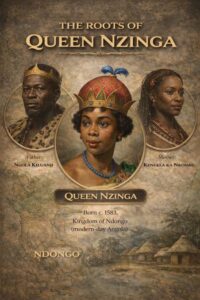
Nzinga was born into the royal family of Ndongo, a kingdom in present-day Angola. After the death of her brother, King Ngola Mbande, in 1624, she broke with patriarchal custom and declared herself Queen.
Her motivation was clear. Portuguese colonizers were steadily seizing land and capturing people for slavery. Ndongo needed a ruler who could negotiate, fight, and adapt. By taking the throne, Nzinga positioned herself as the central figure to halt the kingdom’s collapse and protect her people from enslavement.
One of the earliest stories that defined Nzinga’s reputation took place during peace talks in Luanda in 1622. She met with the Portuguese governor to discuss terms that would protect Ndongo.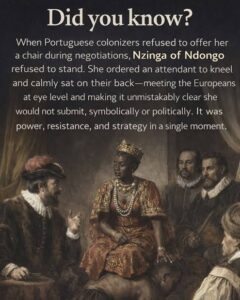
When the governor refused to provide her a chair, signaling that she was inferior, Nzinga responded without hesitation. She ordered one of her attendants to kneel on all fours and used the person as a human seat. By placing herself at eye level with the governor, she communicated a message that would define her rule: Ndongo would negotiate as an equal, not as a subject.
As Portuguese military pressure intensified, Nzinga made a strategic decision to withdraw from Ndongo. She moved her forces and followers to the neighboring Matamba kingdom. There, she conquered the territory and transformed it into a fortified base of resistance.
Matamba became more than a military stronghold. It served as a refuge for escaped slaves and displaced Africans. Nzinga organized agriculture, trade, and defense systems that allowed the kingdom to be self-sustaining. From Matamba, she launched raids, defended borders, and maintained a government that could function independently of Portuguese control.

Nzinga understood that military resistance alone would not be enough. She mastered diplomacy and alliance-building to counter Portuguese power.
She established contact with the Dutch, who were also in conflict with Portugal in Angola. Through this alliance, she secured weapons and support. She also used trade negotiations to gain leverage and, at different points, engaged with Catholic missionaries. Her temporary embrace of Christianity was a political tool to gain legitimacy in European eyes and to secure the release of captives, including members of her own family.
This flexibility, shifting between war, diplomacy, and cultural adaptation, allowed her to keep her kingdom alive for decades despite being surrounded by a stronger colonial power.
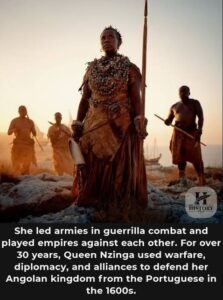
By the 1650s, after nearly 40 years of war and negotiation, Nzinga achieved a major diplomatic victory. In 1656, she signed a peace treaty with Portugal. The treaty recognized her as the legitimate and sovereign ruler of Matamba.
In her final years, she focused on internal stability. She worked to rebuild communities, reintegrate people, and preserve Mbundu culture and identity. She ruled until her death in 1663 at the age of 80. Under her leadership, Matamba remained independent long after her passing.
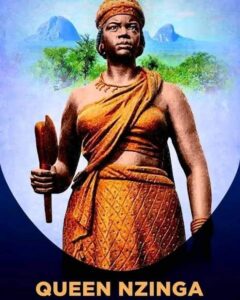
Nzinga’s influence extends far beyond Central Africa. Among Afro-Brazilian communities, particularly during Rio Carnival, she is honored as a legendary queen and ancestor. Songs, plays, and cultural festivals celebrate her intelligence, courage, and refusal to submit.
Historians study her as an early example of statecraft under pressure. She combined military strategy with diplomacy, cultural symbolism with practical governance. She showed how an African ruler could resist colonization not only with weapons but with political skill .
C L I C K T O S E E V I D E O…..
Queen Nzinga Mbande fought for 40 years not for personal power, but because she cherished her people and refused to see them erased by colonization and slavery. From the human chair in Luanda to the fortress of Matamba, and finally to the 1656 peace treaty, she demonstrated that resistance could take many forms.
Her life is a reminder that African history is filled with leaders who defended sovereignty with both sword and strategy. Schools may not teach her story in detail, but her legacy endures in Angola’s national memory and in the cultural traditions of the African diaspora. Queen Nzinga remains a model of leadership under pressure and of a ruler who put her people first…See_More

Leave a Reply