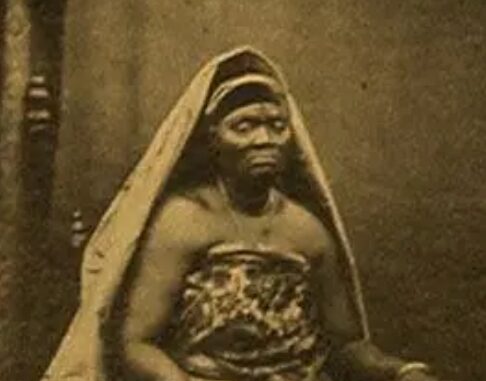
Madam Efunroye Tinubu (c.1810–1887) remains one of the most powerful and debated figures in 19th‑century Yorubaland.
A wealthy trader, political strategist, and titled chief, she played a decisive role in the politics of Lagos and Abeokuta during a turbulent era marked by the Atlantic slave trade, internal Yoruba conflicts, and growing British influence.
Born around 1810 in Ojokodo, in present-day Ogun State, Tinubu rose to prominence through commerce.
She became a successful trader dealing in salt, tobacco, and enslaved people at a time when the Atlantic slave trade was still active. Historical records indicate she built significant wealth from this trade and maintained commercial connections that extended to Brazil and other parts of the Atlantic world.
Like many coastal elites of the period, her early economic power was closely tied to slave-based commerce.
However, the political landscape began shifting in the mid‑19th century. Britain had outlawed the slave trade and increasingly pressured West African coastal states, including Lagos, to abandon it.
At first, Tinubu resisted abolition, as it threatened her economic base. By the 1850s, as British influence deepened and “legitimate” trade in palm oil and other goods expanded, she is documented as having moved away from slave trading and adapted to the new commercial order.
Beyond commerce, Tinubu’s political influence earned her the reputation of a kingmaker. She was deeply involved in the power struggle between Oba Akitoye and Oba Kosoko of Lagos in the 1840s and 1850s.
Using her wealth, influence, and networks, she supported Akitoye’s claim to the throne. The eventual restoration of Akitoye in 1851, aided by British intervention, marked a turning point in Lagos history and paved the way for stronger colonial control.
Tinubu’s assertiveness also brought her into conflict with British officials. She was accused of political interference and of obstructing British objectives.
In 1856, Consul Benjamin Campbell exiled her from Lagos. She relocated to Abeokuta, where she continued to wield considerable influence and was later installed as the Iyalode of Egba, a prestigious chieftaincy title reserved for prominent women.
Her legacy is complex. On one hand, she is celebrated as a pioneering female political leader in a male-dominated era, a woman who commanded wealth, negotiated power, and shaped regional politics.
On the other hand, her early involvement in the slave trade remains a source of moral and historical debate.
Today, Madam Tinubu stands as a figure who embodies both the entrepreneurial dynamism and the ethical contradictions of her time.
Her life reflects the economic realities of 19th‑century West Africa and the political transformations that accompanied the rise of British colonial influence….See More





Leave a Reply