
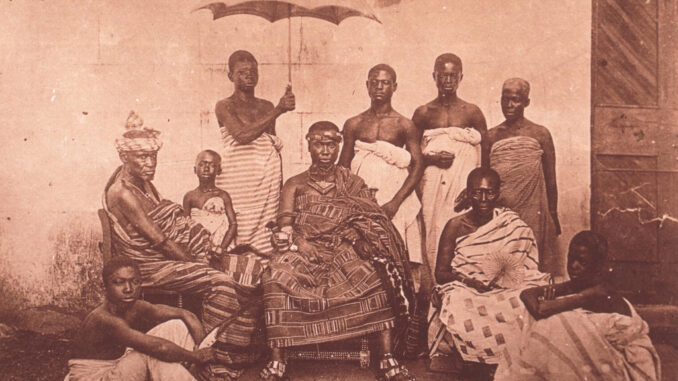
In the late 1800s, as European powers raced to divide Africa, one kingdom in West Africa refused to become a footnote. That kingdom was Ashanti, and its king was Asantehene Agyeman Prempeh I. His decision to reject British demands would cost him his throne, his freedom, and 28 years of his life.
By the 1890s the Scramble for Africa was in full force. After the Berlin Conference of 1884 to 1885, Britain moved to consolidate control over the Gold Coast, present-day Ghana, to secure gold and the growing cocoa trade.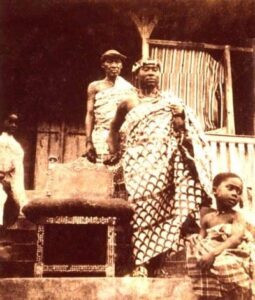
The Ashanti Empire stood in the way. It was not a loose collection of villages. It was a centralized state with a professional army, a complex bureaucracy, and immense wealth from gold and trade routes. For decades Britain and Ashanti had fought several wars. By 1896, London decided it wanted a protectorate, not another war.
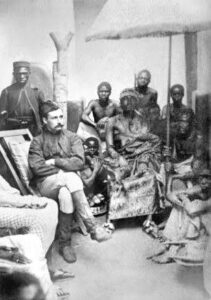
The British sent an ultimatum to Kumasi: accept British authority. Prempeh I refused. It was not only about pride. To accept would mean giving up Ashanti sovereignty and control over its economy. The Golden Stool, Sika Dwa, was the spiritual symbol of the nation. It represented the soul of the Ashanti people, and no foreign power could claim authority over it.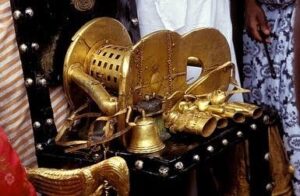
The Expedition and Arrest, 1896
To avoid more bloodshed, Prempeh I chose diplomacy. When British troops under Governor Sir William Maxwell marched into Kumasi, the king agreed to meet them.
What happened next was designed to break morale. British officials forced Prempeh I to bow and kiss the governor’s boots in front of his people and chiefs. It was a public act of humiliation meant to signal that Ashanti authority was finished.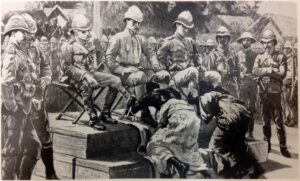
Even after that, the British did not honor any agreement. They arrested Prempeh I, his mother Queen Mother Yaa Akyaa, and senior chiefs. The royal palace was looted. Treasures, regalia, and gold were taken to Britain.
Britain knew an Ashanti king in Ashanti land would always be a rallying point. So they removed him.
First, he was held in Elmina Castle, then sent to Freetown in Sierra Leone from 1896 to 1900. As resistance continued at home, the colonial government moved him farther away, to the Seychelles in the Indian Ocean. He would spend 1900 to 1924 there.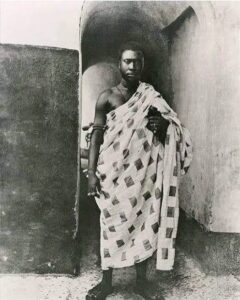
In exile he learned English, studied Western subjects, and kept to royal customs in private. But he was cut off from his people for nearly three decades.
The War of the Golden Stool, 1900
The most famous act of resistance happened while the king was gone. In 1900, Governor Sir Frederick Hodgson demanded to sit on the Golden Stool. To the British it looked like a throne. To the Ashanti it was sacred. No person, not even the Asantehene, was permitted to sit on it.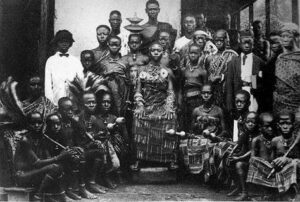
Queen Mother Yaa Asantewaa responded with a speech that shamed men who wanted to surrender. She led an army that besieged the British fort in Kumasi for months. It was one of the largest anti-colonial uprisings in West Africa. British reinforcements eventually crushed the rebellion, and Yaa Asantewaa was also arrested and exiled.
By 1924, Britain concluded that holding Prempeh I was doing more harm than good. They allowed him to return, but with restrictions. He was given the title Kumasihene, King of Kumasi, not Asantehene, King of Ashanti. The empire was to be administered under British law.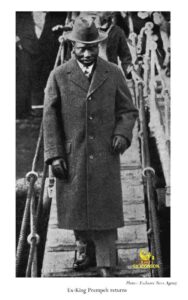
The people ignored the distinction. They received him as their rightful ruler. He spent his last years rebuilding the Ashanti traditional council and institutions until his death in 1931.
Today, Prempeh I and Yaa Asantewaa are national heroes in Ghana. Their story is taught as an example of resistance that preserved culture even when political independence was lost.
Britain conquered Ashanti territory. It never conquered Ashanti identity. The refusal to bow was about more than one man and one queen. It was about whether a nation could be ruled without consent.
Prempeh I paid for that refusal with exile. Yaa Asantewaa paid with war and imprisonment. But because they stood firm, the Golden Stool was never surrendered, and the Ashanti political structure survived colonization.
That is why the story is still told. It shows how colonial power worked, not just through guns, but through symbols, humiliation, and exile. And it shows how African kingdoms fought back, not only on battlefields, but by protecting what gave them meaning…See_More
Leave a Reply