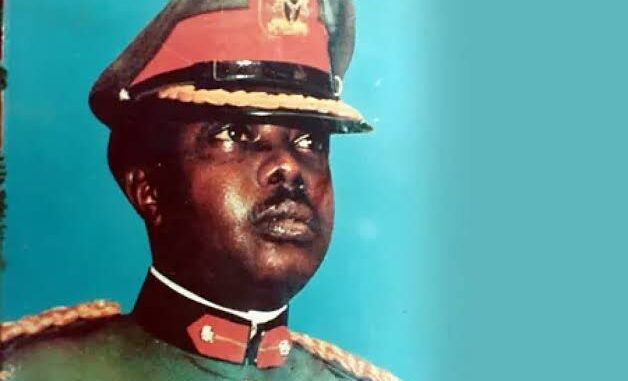
February 13, 1976, remains one of the darkest dates in Nigeria’s political history. On that Friday morning, the Head of State, General Murtala Ramat Mohammed, was assassinated in Lagos during an abortive coup led by disgruntled soldiers.
The killing cut short the tenure of a leader who had come to power just six months earlier with a reputation for discipline, anti-corruption, and bold reforms. Fifty years later, the incident is still remembered as the moment Nigeria lost a leader at the peak of public goodwill.
General Murtala Mohammed took office on July 29, 1975, after a bloodless coup that removed General Yakubu Gowon. He immediately set a new tone for government. His administration launched a massive purge of the civil service, introduced austerity measures, and projected a more assertive foreign policy, particularly on Southern Africa and decolonization.
By early 1976, Murtala had announced a timetable for return to civilian rule, created 7 new states, and moved the federal capital from Lagos to Abuja. His direct style and public appearances made him popular, but they also created enemies within the military establishment who felt sidelined by the reforms.
Friday, February 13, 1976, shortly after 8:00 a.m.
Location: Near the Federal Secretariat in Ikoyi, Lagos. Murtala was in a convoy heading to Dodan Barracks, the seat of government.
According to official accounts, the Head of State’s black Mercedes-Benz was caught in traffic. Assailants emerged from an adjacent petrol station and opened fire at close range. The attack was swift and targeted. General Murtala Mohammed was killed instantly. Also killed were his driver and his ADC, Lieutenant Akintunde Akinsehinwa.
The original bullet-riddled Mercedes-Benz was later preserved by the government and has been displayed at various times as a historic artifact of the event.
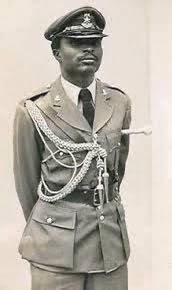
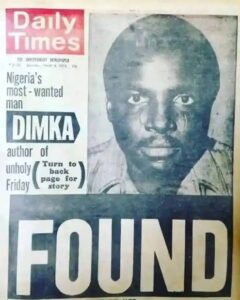
The coup was led by Lieutenant Colonel Buka Suka Dimka, a former head of the Army Physical Training Corps. Dimka and his group of junior and middle-ranking officers were dissatisfied with what they termed the government’s centralization of power and failure to address grievances in the military.
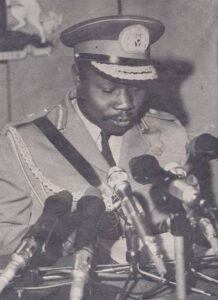
Within hours of the shooting, Dimka went on Radio Nigeria to announce that the government had been overthrown. In the broadcast, he accused the administration of maladministration, weakness, and corruption. He called on Nigerians to support the new regime.
However, the plot lacked coordination and broad support. Key formations in Lagos, Kaduna, and other barracks did not join. Loyalist officers, including then-Colonel Ibrahim Babangida and other commanders, quickly mobilized to contain the uprising. By the end of the day, the coup had collapsed.
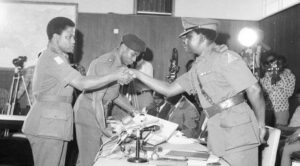
In line with the chain of command, General Olusegun Obasanjo, Murtala’s Chief of Staff, Supreme Headquarters, was sworn in as Head of State. Obasanjo pledged to continue Murtala’s policies and the transition program. The government declared a period of national mourning and launched a nationwide manhunt for the coup plotters.
The failure of the coup reinforced the military’s commitment to a structured return to civilian rule, a policy Murtala had initiated before his death.
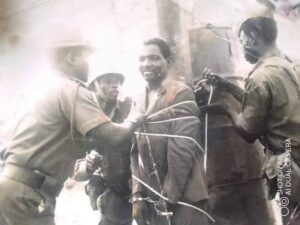
Dimka initially escaped from Lagos and went into hiding. After several weeks on the run, he was arrested near Abakaliki in present-day Ebonyi State in southeastern Nigeria.
A special military tribunal was constituted to try Dimka and his co-conspirators. Among those tried was Major General I.D. Bisalla, the former Commissioner for Defense, who was accused of complicity.
In May 1976, the tribunal found Dimka, Bisalla, and several other officers guilty of treason and murder. They were executed by firing squad. The government used the trials to send a strong message against insubordination and political violence in the armed forces.
General Murtala Mohammed was 37 years old when he died. Despite his short time in office, his impact was significant. He is credited with professionalizing the civil service, giving Nigeria a more independent voice in African affairs, and laying the foundation for the current 36-state structure.
To honor him, the Federal Government named the nation’s busiest airport, Murtala Muhammed International Airport in Lagos, after him. His portrait also appears on the Nigerian 20 Naira note.
Historians often debate what Nigeria would have looked like had Murtala completed his term. His death created a leadership vacuum that Obasanjo filled, and the country eventually returned to civilian rule in 1979 as planned.
The assassination of General Murtala Mohammed was not just the killing of a Head of State. It was an attack on a reform agenda that many Nigerians had embraced. The events of February 13, 1976, revealed the fragility of military politics, but also the resilience of state institutions that managed a peaceful succession.
Fifty years on, Murtala is remembered less for how he died and more for how he governed in the brief period he had. The bullet marks on his car remain a physical reminder, but his legacy lives in the institutions, policies, and national symbols that still carry his name…See_More

Leave a Reply