Between 1901 and 1902, the British Empire fought a war in southeastern Nigeria that changed Igboland forever. It is called the Anglo-Aro War. Outside of specialist history books, few people learn about it, yet it marked the moment Britain broke the most powerful political and spiritual network in the region and imposed direct colonial rule.
The Aro were a subgroup of the Igbo. They did not rule through one king with a standing army. Instead, they built influence through three systems.
The Aro were custodians of the Ibini Ukpabi oracle, known to the British as the Long Juju. Communities across Igboland and beyond brought disputes to the oracle for judgment on land, trade, and crime. The decisions were respected.
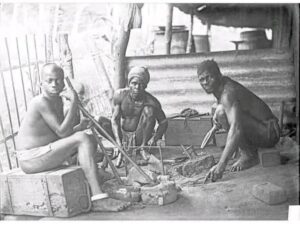
The Aro dominated trade routes from the interior to the coast. They moved palm oil, cloth, and other goods, and before abolition they were also involved in the slave trade. Because they linked producers to coastal merchants, they acted as middlemen for much of the region.
The Aro worked with warrior groups such as the Ohafia, Abam, and Edda to enforce oracle decisions and protect trade. This network gave them reach without needing a centralized state.
By the late 1800s Britain had the Niger Coast Protectorate and wanted to expand inland. The problem was the Aro monopoly.
Economically, Europe’s Industrial Revolution needed palm oil for soap and lubricants. Britain wanted direct access to producers, not to pay Aro traders.
Politically, Britain could not accept a rival authority. Villages often obeyed the oracle more than British courts.
To justify intervention, British officials portrayed the Ibini Ukpabi as a site of human sacrifice and fraud. That “civilizing” argument helped sell the war at home.
The Military Campaign, 1901–1902
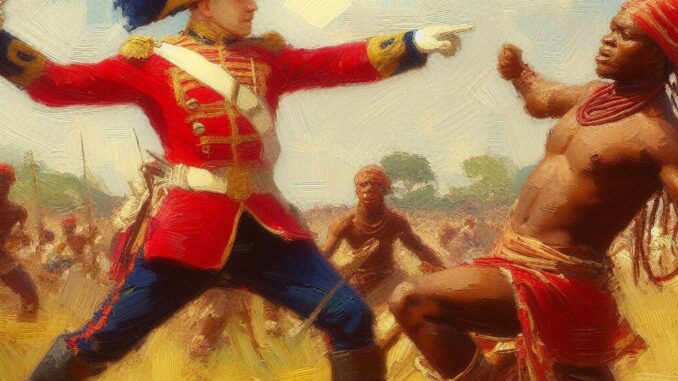
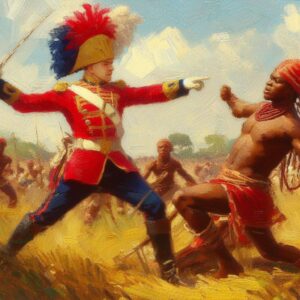
In November 1901, Britain sent the Aro Field Force under Colonel Arthur Montanaro. It was a multi-column invasion designed to hit the Confederacy from several directions.
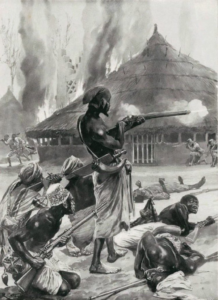
The British had Maxim machine guns, artillery, and disciplined columns. The Aro and their allies could not match that firepower in open battle, so they used guerrilla tactics. They used ambushes, snipers, and the dense rainforest to slow the advance.
Despite resistance, British forces reached Arochukwu in December 1901. They blew up the Ibini Ukpabi shrine. The goal was to destroy the spiritual center and break Aro authority. Fighting did not end immediately. Insurgency continued into the spring of 1902, but the Confederacy’s network was shattered.
Aftermath and Systemic Legacy
The defeat of the Aro opened southeastern Nigeria to full British administration, and it created problems that lasted for decades.
The biggest change was governance. Igbo communities traditionally had no kings. Decisions were made by elders, age grades, and title societies. The British did not understand this. To collect taxes and enforce orders, they created “Warrant Chiefs” and gave them powers they never had before. Many of these appointees were corrupt or unpopular, and that led to resentment and later revolts, including the Aba Women’s War of 1929.
Religion and education also shifted. With the oracle destroyed, Christian missionaries moved into the interior. Schools and churches replaced shrines as centers of authority. Over time, traditional institutions lost political power.
There was also a memory gap. Colonial textbooks described the campaign as “pacification” of scattered tribes. They did not teach that the British had fought and defeated a sophisticated regional network. As a result, generations of Igbo students grew up without a clear story of the war, even though it determined who would rule their towns for the next 60 years.
The Anglo-Aro War was not just a battle. It was the collision of two systems. One was a decentralized, trade and oracle-based network. The other was a colonial state that wanted direct control of land, labor, and resources.
When the Aro system fell, the British replaced it with chiefs, courts, and mission schools. That structure shaped politics in the Southeast through independence and beyond.
Remembering the war does not mean glorifying one side or the other. It means restoring a missing chapter. The Aro Confederacy showed that Igboland was not without organization before colonization. And the British campaign showed how economic interests, military technology, and cultural disruption were used to impose a new order.
The Anglo-Aro War is often left out of Nigerian history lessons. But to understand modern governance, religion, and politics in the Southeast, you have to go back to 1901, to Arochukwu, and to the day the Long Juju fell…See_More



Leave a Reply