
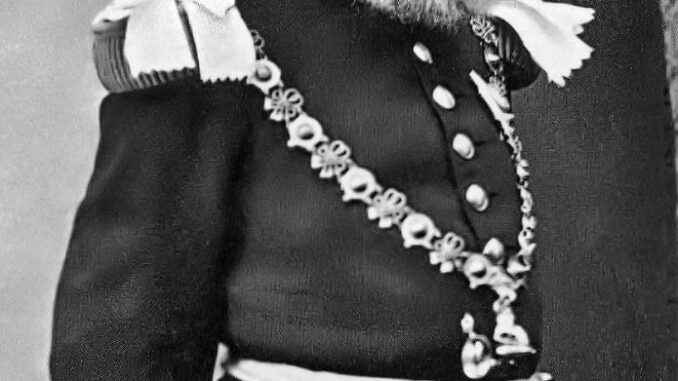
Between 1885 and 1908, the Congo Free State was not a colony of Belgium. It was the personal property of one man, King Leopold II of Belgium. Under the guise of philanthropy and free trade, Leopold turned a territory the size of Western Europe into a forced labor camp. The result was one of the deadliest episodes of colonial rule in modern history.
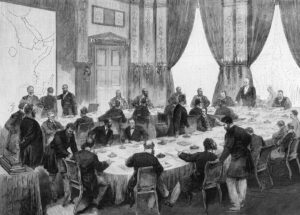
At the Berlin Conference in 1885, European powers divided Africa. Leopold presented his Association Internationale du Congo as a charitable mission. He promised to bring Christianity, end Arab slave trading, and open the Congo River to commerce. European leaders accepted the claim because it sounded noble and because it kept other powers out.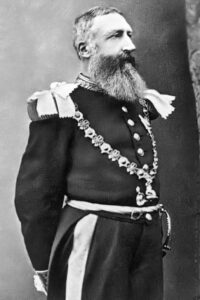
In reality the Congo Free State belonged to Leopold alone. He ran it like a private company. The stated goals of civilization and trade were cover for a single objective: extract as much wealth as possible with as little cost as possible.
The boom came with rubber. When inflatable tires were invented in the 1890s, demand for wild rubber exploded. The Congo had vast forests of rubber vines, and Leopold wanted them harvested.
He did not pay wages. Instead he created a system of quotas enforced by the Force Publique, the colonial army. Every village was told how much rubber it had to deliver. If the quota was not met, soldiers took hostages, burned villages, raped women, and carried out executions. Families were held until enough rubber arrived.
This was not war. It was economic extraction enforced by terror. The goal was not governance. It was volume.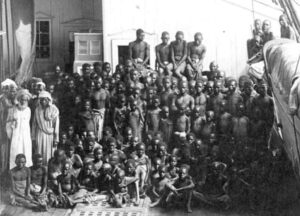
Because ammunition was expensive, soldiers were required to account for every bullet. The rule became infamous: for each bullet fired, a soldier had to bring back one severed right hand. The stated reason was to prove the bullet was not wasted on hunting or sold.
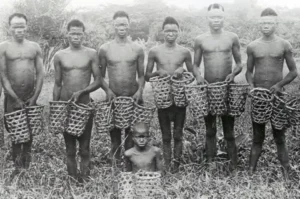
In practice it created a grim economy. Hands were cut from the living, including children, to make up for shortfalls. Hands were also cut from the dead to meet quotas. Photographs and missionary reports later showed baskets of severed hands, and piles of bodies. The image became the symbol of Leopold’s rule.
Leopold’s propaganda held for years because few outsiders saw the interior. That changed with a small group of witnesses.
George Washington Williams, an African-American journalist and minister, traveled to the Congo in 1890. He wrote an open letter to Leopold describing murder, slavery, and theft, and he was the first to use the phrase crimes against humanity.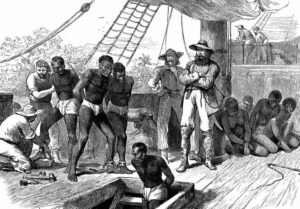
E.D. Morel, a British shipping clerk, noticed the trade pattern. Ships left Belgium for the Congo full of guns and chains. Ships returned full of rubber and ivory. He realized the Congo was not a free trade zone. It was a slave state.
Alice Seeley Harris, a missionary, took photographs of mutilated children. Her images were shown across Europe and America. For the first time, the public could see what the reports described.
The pressure forced change. In 1908, under international outrage, Leopold was compelled to transfer the Congo Free State to the Belgian government.
Before the handover, Leopold ordered many colonial archives burned. Still, the evidence that survived was enough.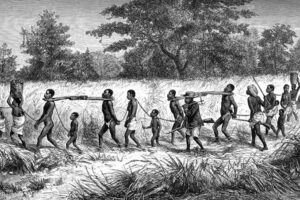
Historians estimate that the population of the Congo fell by roughly 10 million during Leopold’s rule. The causes were direct killings, but also disease, starvation, and a collapse in birth rates because men were taken for forced labor and families were broken.
The Congo Free State left deep scars. It destroyed local political systems, created a culture of violence, and extracted wealth that never returned. It also created something new: one of the first modern international human rights campaigns, built by journalists, missionaries, and activists who used letters, speeches, and photographs to challenge a king.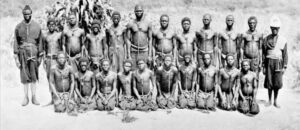
King Leopold II died in 1909, rich and largely unpunished. The story of his reign was buried for decades under the language of exploration and progress. Remembering it matters not to assign blame to people today, but to understand how a private profit motive, backed by state power and global demand, can turn an entire country into a crime scene…See_More
Leave a Reply