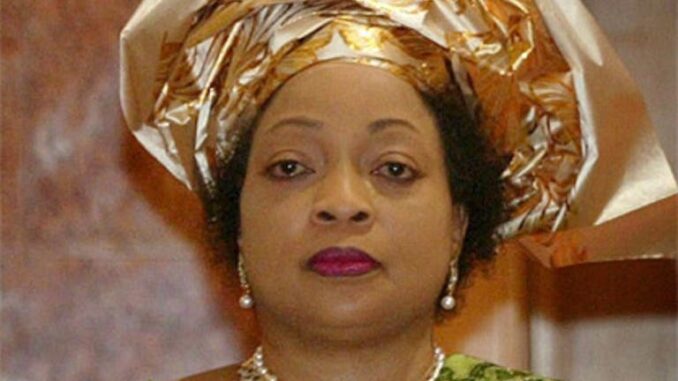
Twenty-one years have passed since Nigeria lost Stella Abebe Shonekan Obasanjo, but the memory of her sudden death still lingers in public consciousness.
For a long time, Nigerians were left with more questions than answers. The official word at the time pointed to a sudden asthma attack. It was only years later, after a Spanish court handed down its verdict, that the real story behind the death of the former First Lady came into full view.
Stella Obasanjo was born on November 14, 1945, and married Olusegun Obasanjo in 1963.
When her husband returned as civilian President in 1999, she stepped into the role of First Lady and made it one of the most visible in Nigeria’s history. She was glamorous, outspoken, and unafraid to speak on issues that mattered to women and children.
While some at home nicknamed her “Greedy Stella,” she preferred to be called “Mother of the Nation.” Through her Child Care Trust, she pushed for better welfare for vulnerable children and spoke often about maternal health and education.
Her daughter, Iyabo, would later describe her as a firm mother whose discipline came through serious conversations rather than beatings, lessons that stayed with her into adulthood.
In October 2005, at the age of 59, Stella traveled to Marbella on Spain’s Mediterranean coast. She went for treatment at a private cosmetic surgery clinic. Days later, news broke that she had died suddenly. The initial explanation given in Nigeria was that she had suffered a fatal asthma attack. The news shocked the nation.
President Obasanjo declared a period of national mourning, and she was buried in Ota, Ogun State.
The mystery surrounding her death persisted until May 2009, when a court in Malaga, Spain, concluded a four-year investigation. The man at the center of the case was Dr. Antonio Mena Molina, the cosmetic surgeon who had performed the procedure.
The court found that she had gone in for liposuction, but the operation took a catastrophic turn. According to evidence presented during the trial, the tube used to remove fat was placed incorrectly.
Instead of staying within the fat layer, it entered the abdominal cavity, puncturing her colon and cutting into her liver.
In the days that followed, clinic staff grew alarmed by her condition. They tried to reach the surgeon, but his phone was switched off.
When contact was finally made, Mrs. Obasanjo was bleeding heavily. Rather than calling an ambulance, Dr. Mena drove her to a hospital himself. By the time they arrived, she was already brain dead.
The court did not accept the earlier explanation of an asthma attack. It convicted Dr. Mena Molina of negligent homicide.
He was sentenced to one year in prison, fined €120,000, and banned from practicing medicine for three years. The judgment finally gave Nigerians a clear answer: her death was the result of surgical complications and a failure in post-operative care.
Her passing sparked more than grief. It reopened a national conversation about medical tourism. Many Nigerians asked why senior public officials sought treatment abroad while hospitals at home struggled with poor funding and equipment.
For others, her death became a painful symbol of a system people no longer trusted with their lives.
Beyond the tragedy, Stella Obasanjo is remembered for how she used the office of First Lady. She broke away from a quiet, ceremonial role and chose to be present, vocal, and involved.
The Child Care Trust she founded continued after her, and her name still comes up whenever Nigeria debates the role of First Ladies or the state of healthcare.
Twenty-one years later, the story is no longer shrouded in speculation. A Spanish courtroom confirmed what many had feared: a cosmetic procedure gone wrong, a delayed response, and a life lost too soon….See More









Leave a Reply