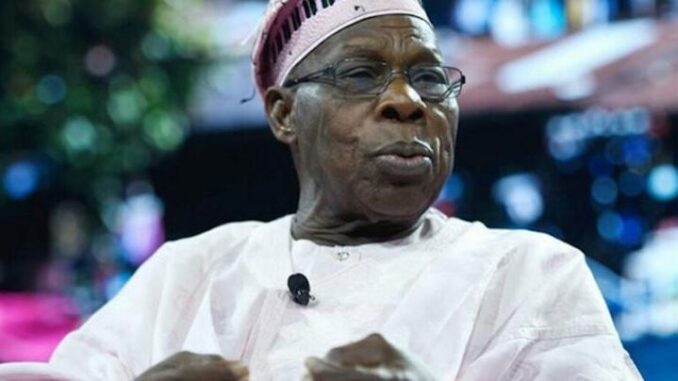
According to a report by This Day Live on Monday, April 27, 2026, Olusegun Obasanjo, Former President, has stated that any government that cannot secure the lives and property of its citizens lacks justification to remain in power, presenting a firm position on the deteriorating security situation in Nigeria and the leadership issues affecting the country.
He attributed the country’s mounting difficulties to ineffective leadership, noting that Nigeria’s standing on the global stage has weakened over time.
He added that the nation has failed to properly manage its relationships within regional bodies, particularly the Economic Community of West African States, leading to reduced influence and missed opportunities.
Speaking during an appearance on News Central’s Soni Irabor Live programme, Obasanjo said Nigeria no longer plays a significant role in global decision-making.
He explained that the country’s absence from key international discussions highlights a broader problem rooted in leadership shortcomings and declining strategic engagement beyond its borders.
Addressing insecurity across the country, the former leader stressed that citizens should not normalize kidnapping and other criminal activities.
He recalled a time when Nigerians could move freely across regions without fear, contrasting it with the current situation where safety has become a major concern nationwide.
He criticized the federal government’s handling of security, asserting that any administration unable to protect its citizens has effectively lost its legitimacy.
According to him, governance must prioritize safety, and failure in that regard reflects a deeper structural weakness in leadership and policy implementation.
Obasanjo linked the origins of the current security challenges to the period following the civil war, when the spread of weapons was not adequately controlled.
He explained that the situation has worsened over time due to neglect and poor governance.
He also pointed to both internal and external influences, including the return of armed fighters after the fall of Muammar Gaddafi in Libya, as well as the use of armed groups for political interests within Nigeria.
He further warned about the implications of a growing population of out-of-school children, estimated at about 20 million, describing it as a potential threat to long-term national security due to the risk of recruitment into criminal or extremist groups.
On the political structure, he cautioned against the development of a one-party system, stating that it would be harmful to Nigeria’s democratic progress.
While acknowledging assurances from Bola Tinubu regarding the matter, he maintained that such a system would not be beneficial to the country.
He said, “The other day, somebody came to me and said, well, from NIPSS (National Institute for Policy and Strategic Studies), they were looking into the causes of insecurity. And I said, what is this about? He said the government has asked them to do this. He (Tinubu) said he will not want to see a one-party state in Nigeria. He said that. And, as I said, I will for once want to take his word for it. It will be a pity. Because it will not even serve its own purpose….See More




Leave a Reply