
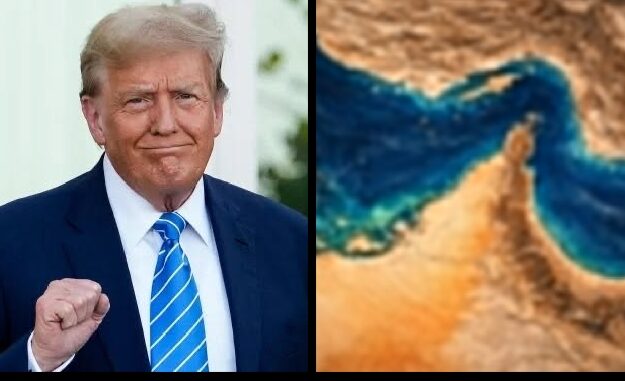
President Donald Trump has announced that Iran has fully reopened the Strait of Hormuz for shipping, ending a blockade that had disrupted global oil flows and sent energy prices soaring for months. The declaration, reported by BRICSinfo.
The reopening comes as part of a fragile ceasefire agreement reached in April following months of military escalation that saw both Iranian closure of the strait and American aerial campaigns and naval operations aimed at forcing the waterway back open.
Iran’s blockade of the Strait of Hormuz began in February 2026 during the height of US-Israeli military actions against Iranian territory. Tehran deployed naval mines, positioned anti-ship missiles along the coastline, and used fast attack boats to threaten commercial shipping in retaliation for strikes on Iranian military and nuclear facilities. The closure disrupted between 20% and 30% of global oil flows, as the strait serves as the only maritime route for petroleum exports from Saudi Arabia, Iraq, UAE, Kuwait, and other Gulf producers in addition to Iran itself. Global oil prices spiked dramatically, with benchmark crude surging past levels not seen since previous major Middle East conflicts, creating economic pain worldwide through higher fuel costs and inflation.
The United States responded to Iran’s blockade with intensive aerial campaigns targeting Iranian naval assets, coastal defenses, and command infrastructure around the strait.
American forces also established their own naval blockade specifically targeting Iranian shipping while attempting to keep the waterway open for other nations’ commercial traffic. The USS Abraham Lincoln carrier strike group led enforcement operations, though the conflicting blockades and military tensions made the strait extremely dangerous for commercial shipping regardless of official assurances.
Many shipping companies simply refused to risk transiting the area, leading to massive disruptions in global energy markets and supply chains even when passage was theoretically possible.
“Iran has fully reopened the Strait of Hormuz for shipping,” President Trump stated according to the BRICSinfo report, marking the announcement as a significant diplomatic and military achievement for his administration. The statement suggests that the fragile ceasefire agreement reached in April included specific provisions guaranteeing freedom of navigation through the strait, addressing one of the key economic and strategic issues that had made the conflict so globally consequential.
Trump has characterized the reopening as validation of his administration’s maximum pressure approach, arguing that military force and economic sanctions brought Iran to the negotiating table and forced concessions on this critical issue.
Oil markets reacted immediately to news of the reopening, with early reports indicating crude prices dropped approximately 10% as traders anticipated the restoration of normal supply flows from the Persian Gulf. Energy analysts noted that while prices remained elevated compared to pre-crisis levels due to ongoing geopolitical uncertainty and production disruptions caused by months of conflict, the reopening of the strait removes the most acute supply constraint and should allow gradual price normalization if the ceasefire holds.
Major oil-importing nations including China, India, Japan, and European countries stand to benefit significantly from restored access to Gulf petroleum at more reasonable prices.
However, public reactions reflected widespread skepticism about both the completeness of the reopening and the long-term stability of the arrangement.
Social media replies to the announcement questioned whether Iran had genuinely removed all obstacles to navigation or merely reduced visible military presence while maintaining the capability to reimpose closure quickly if the ceasefire collapses.
Others noted that commercial shipping companies, having been burned by the sudden February blockade, may remain reluctant to transit the strait without sustained evidence of safety, meaning actual oil flow restoration could lag behind official reopening announcements….See More
Leave a Reply