President Bola Tinubu has sparked widespread controversy with remarks claiming he took over leadership from himself because former President Muhammadu Buhari is essentially the same as him and was his partner in governance.
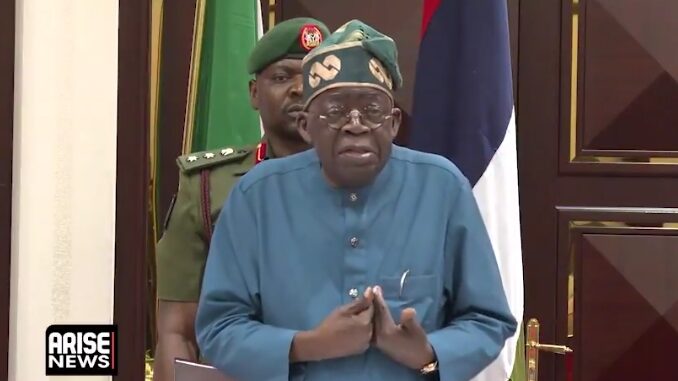
The statement, captured in a video clip shared by popular Nigerian blog Instablog9ja, shows Tinubu addressing an audience while framing his administration as a direct continuation of Buhari’s eight-year tenure rather than a fresh start.
The President went further to assert that critics who cannot see the progress being made will be provided with eyeglasses, a comment that drew applause from his immediate audience but generated furious reactions across social media from Nigerians struggling with inflation, fuel costs, and declining living standards.
The video shows Tinubu speaking confidently to what appears to be a gathering of supporters or party faithful, emphasizing themes of renewed hope, infrastructure development, and economic growth.
“I took over leadership from myself; Buhari is me, he was my partner,” the President stated in the clip, explicitly linking his administration to his predecessor’s legacy. The framing suggests Tinubu views continuity with Buhari’s policies and approach as something to celebrate rather than distance himself from, despite widespread public dissatisfaction with economic conditions that deteriorated significantly during Buhari’s final years in office and have worsened further under Tinubu’s first year.
The context of Tinubu’s remarks is crucial to understanding the backlash they generated. The All Progressives Congress, which both Buhari and Tinubu belong to, has now governed Nigeria continuously since 2015, meaning 2026 marks eleven years of APC rule at the federal level.
During this period, Nigeria has experienced severe economic challenges including multiple currency devaluations, soaring inflation that recently exceeded 30%, dramatic increases in fuel prices following subsidy removal, widespread insecurity across multiple regions, and declining foreign investment. Many Nigerians had hoped that Tinubu’s election would bring fresh approaches to these problems, but his identification with Buhari’s record suggests policy continuity rather than change.
Tinubu’s assertion that critics who cannot see progress will be given eyeglasses was clearly intended as a humorous jab at opposition voices, and it drew laughter and applause from his immediate audience.
However, the comment struck many Nigerians as tone-deaf and dismissive of legitimate grievances about worsening living conditions. Citizens struggling to afford basic food items, transportation, and healthcare due to inflation and stagnant wages found the suggestion that their problems stem from inability to see progress rather than actual policy failures deeply insulting.
The eyeglasses comment quickly became a focal point for mockery and criticism across social media platforms.
Public reaction to the video has been overwhelmingly negative outside of APC partisan circles. Social media replies criticized the eleven-year continuity narrative, with many Nigerians arguing that if Tinubu and Buhari are indeed partners who represent continuation of the same leadership, then Tinubu must accept responsibility for all the failures of the past decade rather than claiming credit only for supposed successes.
Critics pointed out that framing himself as Buhari’s continuation undermines any attempt to blame inherited problems for current difficulties, since by his own admission he was part of the previous administration’s decision-making.
The engagement with the video has been massive, with thousands of comments, shares, and quote-tweets dissecting Tinubu’s claims. Many responses included sarcastic requests for the promised eyeglasses, with users posting images of their empty bank accounts, high food prices, and deteriorating infrastructure while asking if special glasses would make these problems disappear.
Others noted that no amount of eyeglasses would help citizens see progress that does not exist, arguing that the fundamental issue is failed policies rather than public perception….See More




Leave a Reply