Across social media and oral history circles, a story keeps resurfacing: _that before the Eri migrants, before Nri and Igbo-Ukwu, the forests of Igboland and the Niger Delta were home to a people of small stature known as dwarfs_. The claim is often framed as “the record no one ever told you.” Here’s what the traditions say, what they may mean, and where archaeology stands today.
Moncom, and Forest Memory
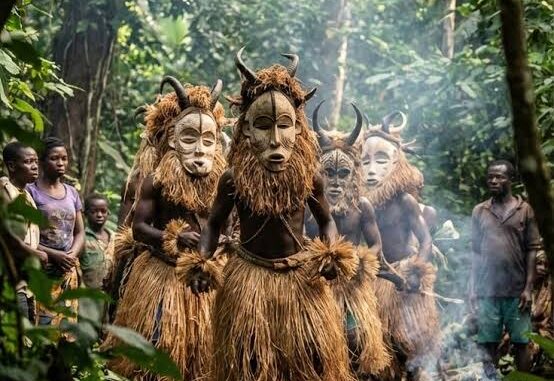
In Igbo oral tradition, names like Wuansi appear in some communities to describe small, secretive forest people. In Ecom, Cross River State, similar figures are called Moncom. The stories are not unique to West Africa. Cultures from Egypt to India to Australia have myths of ancestral “little people” who guarded sacred knowledge, lived in caves or dense forest, and appeared at the edge of human settlement.
In Igboland, these figures are often described as neither fully spirit nor fully human. They are boundary beings — between bush and town, past and present.
Tradition credits these dwarfs with unusual skill. They are said to have been spiritually gifted, with advanced knowledge of ironworking, bronze casting, and ritual medicine. Some versions say they were the first to mark land, set shrines, and teach hunting and farming.
Later migrants, including groups associated with Eri, are said to have met, traded with, and eventually intermarried with them. In that telling, the dwarfs did not “disappear” — they were absorbed, their knowledge carried forward into the clans that followed.
The most concrete link people make is to the Ikom Monoliths of Cross River State — more than 300 carved stones known locally as Akwanshi. The pillars bear faces, geometric patterns, and linear marks.
Researchers like the late Prof. Catherine Acholonu argued the carvings could be a proto-writing system and evidence of a very advanced, ancient civilization tied to the Moncom. Mainstream archaeology dates the Ikom stones broadly to the last 1,500–2,000 years, though exact dating remains debated. Scholars agree they are ritual/commemorative, but they do not currently accept them as the source of Sumerian or Egyptian writing. Still, the monoliths are real, impressive, and under-studied — and they keep the “dwarf builders” story alive.
Some presenters draw parallels between the Wuansi/Moncom and figures like Bes, the Egyptian dwarf god of protection, or forest beings in the Ramayana epic. The idea is that scattered myths may preserve fragments of a real, very ancient encounter between small-statured forest groups and expanding farming societies.
Anthropologists caution against direct one-to-one links across continents. What is clearer is that many societies independently developed “little people” myths to explain the unseen, the skilled outsider, or the older occupants of the forest.
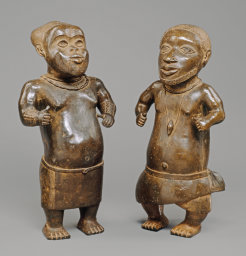
MVK_64745_.tif
Archaeology in southeastern Nigeria confirms deep time. Sites like Ugwu-Ele and the broader Stone Age record show humans have lived in the region for millennia. Igbo-Ukwu [9th–10th century AD] reveals sophisticated bronze and beadwork. That confirms antiquity and craft — but it does not confirm a distinct “race of dwarfs” 4,000 years ago.
Most historians and folklorists read the dwarf stories as symbolic memory: echoes of early hunter-gatherer bands, specialized craft guilds, or spiritual guardians of the land. The “small stature” may be metaphor — for humility, secrecy, closeness to the earth, or spiritual power — rather than literal height.
The “dwarf people” story is powerful because it names something many communities already feel: that Igboland and the Niger Delta sit on layers of older memory. The Wuansi/Moncom traditions, the Ikom Monoliths, and the craft legends point to a heritage that is old, skilled, and spiritual.
Whether that was a literal race of dwarfs, a guild of master artisans, or a way of remembering the forest’s first custodians, remains debated. What is not debated is that the region’s human story runs very deep — and that the stones, shrines, and stories still have much to tell us…See More









Leave a Reply