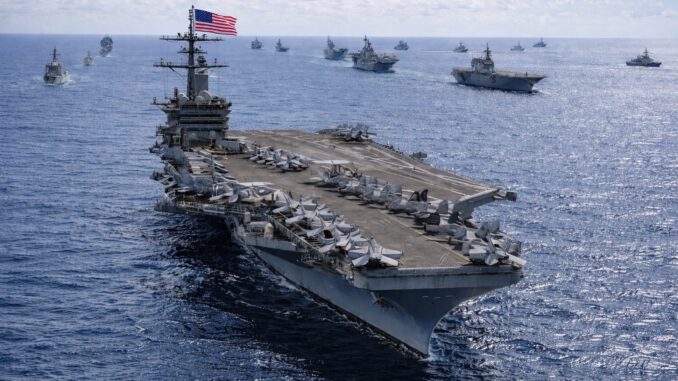
The United States military has directed the USS Abraham Lincoln carrier strike group to enforce a naval blockade in the Strait of Hormuz targeting Iranian ports and shipping, according to a report by BRICSinfo.
The operation represents a dramatic escalation in tensions between Washington and Tehran, with American warships physically turning back vessels attempting to conduct maritime trade with Iran in one of the world’s most critical energy chokepoints.
The deployment follows the collapse of ceasefire talks and marks the implementation of what amounts to an economic siege against the Islamic Republic through control of the narrow waterway that carries approximately 20% of global oil supplies.
The blockade operations were initiated by US Central Command around April 13, 2026, according to confirmed military sources. Multiple warships from the Abraham Lincoln carrier strike group, which includes guided-missile cruisers, destroyers, and support vessels in addition to the nuclear-powered aircraft carrier itself, have taken up positions in and around the Strait of Hormuz with explicit orders to restrict Iranian maritime trade.
Vessels approaching Iranian ports or departing from them have been intercepted, inspected, and in many cases turned back, effectively cutting off Iran’s ability to conduct seaborne commerce.
The operation represents one of the most aggressive uses of American naval power in the region since the Iraq War.
The timing of the blockade corresponds with the breakdown of ceasefire negotiations related to the broader US-Israel-Iran conflict that has been escalating throughout early 2026. According to diplomatic sources, talks aimed at de-escalating tensions and establishing frameworks for regional stability collapsed in early April, with each side blaming the other for intransigence.
Within days of the diplomatic failure, US Central Command issued orders for the naval blockade, suggesting that the military option had been prepared in advance as a contingency should negotiations fail. The speed of implementation indicates significant pre-positioning and planning by American forces in the region.
The Strait of Hormuz is a 21-mile-wide passage at its narrowest point, separating Iran from the Arabian Peninsula and serving as the only maritime route between the Persian Gulf and the open ocean.
Its strategic importance cannot be overstated, as approximately one-fifth of all petroleum traded globally passes through this chokepoint daily. Saudi Arabia, Iraq, the United Arab Emirates, Kuwait, and other major oil producers depend on the strait to export their production to global markets.
By establishing a blockade in this location, the United States is wielding enormous leverage not just over Iran but over global energy markets and the broader world economy.
US military officials have emphasized that the blockade specifically targets Iranian traffic while preserving freedom of navigation for other nations.
According to statements from Central Command, vessels not engaged in trade with Iran are being allowed to pass through the strait without significant interference, though all shipping is subject to increased inspection and monitoring.
This distinction is meant to minimize the economic impact on American allies in the Gulf region and avoid a complete shutdown of global oil flows that would trigger energy prices to spike catastrophically.
However, the practical implementation of selectively blockading one nation’s shipping while allowing others to pass in such congested waters presents significant operational challenges.
The operation has already demonstrated its impact on Iranian commerce. Multiple cargo vessels that had been scheduled to deliver goods to Iranian ports or collect exports have been intercepted by American warships and ordered to reverse course.
In some cases, ships have been boarded by US Navy personnel for inspection before being released or turned back depending on their cargo and destination. The cumulative effect has been to severely restrict Iran’s ability to import essential goods or export its own products, particularly oil, which remains the country’s primary source of foreign currency despite years of sanctions.
“US Central Command has initiated operations to restrict Iranian maritime activity in accordance with national security directives,” a military spokesperson stated, though official public statements have avoided using the term “blockade” due to its legal implications under international law.
A naval blockade is traditionally considered an act of war, and by characterizing the operation differently, the US may be attempting to maintain legal ambiguity about the status of its confrontation with Iran. However, the practical effect of turning back ships and preventing trade clearly constitutes a blockade regardless of the terminology used….See More




Leave a Reply