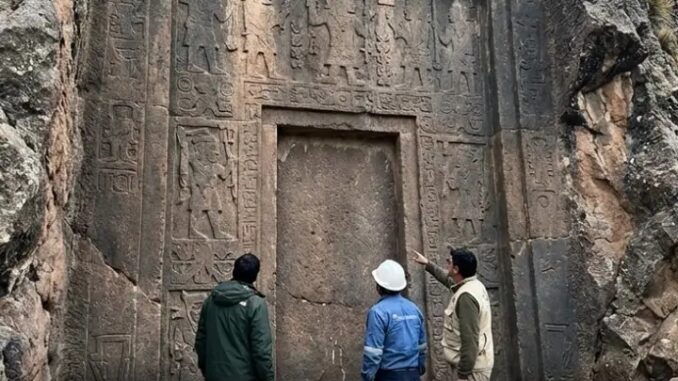
High in the mountains of Peru, carved into a cliff face that overlooks a landscape unchanged for millennia, there stands a door that should not exist.
It is massive, cut from a single slab of solid stone. Its surface is smooth and precise in a way that seems impossible for the era in which it was created. There are no handles. There are no hinges. There is no visible mechanism of any kind. Just silence, and a mystery that has haunted archaeologists for decades.
For over 4,000 years, this megalithic door has remained sealed. No one alive today knows what lies behind it. No one knows who built it or why. And perhaps most unsettling of all, no one knows how it was made.
The door is located near Lake Titicaca, in a region of Peru that was home to ancient civilizations long before the Inca Empire rose to power. The area is known for megalithic sites like Puma Punku and Sacsayhuamán, but this cliff-carved entrance is different.
The stone slab fits into the surrounding rock with a precision that modern engineers still struggle to explain. There are no gaps, no spaces where tools could be inserted to pry it open. The edges align so perfectly with the cliff face that it appears to have grown there naturally, as if the mountain itself chose to form this shape.
And yet the carved details on its surface make it clear that human hands were involved. At the center is a smaller, door-shaped recess, as if it were meant to be touched, pressed, or used as a key.
Local legends speak of this place as a gateway, though a gateway to what depends on who you ask.
Some indigenous traditions describe it as a portal to the realm of the gods, a threshold that only the worthy could cross. Others believe it was a ceremonial monument, never intended to open at all, but carved to represent the boundary between the world of the living and whatever lies beyond.
Researchers have examined the site extensively. Using ground-penetrating radar and other non-invasive technologies, they have searched for chambers or passages behind the sealed entrance. Some studies have suggested the presence of hollow spaces beyond the door, though the results remain inconclusive. Without opening it, there is no way to know for certain what secrets it guards.
But opening it may be impossible. The door is sealed so tightly that there is no obvious point of entry.
Some theorists suggest the ancient builders used a counterweight system, a mechanism that would allow the massive stone to swing open under specific conditions. Others argue the door was sealed intentionally after something was placed inside, never meant to be opened again. A few more imaginative voices propose engineering knowledge we have since lost.
The local Aymara people have their own explanation. According to oral tradition, this door was used only once. A priest-king carried a golden disc said to be a gift from the gods. He placed his hands upon the smaller carved recess, and the door opened to reveal a tunnel filled with light. The priest-king entered and was never seen again. The door closed behind him, and it has not opened since.
Whether this story is mythology, cultural memory, or something else entirely remains a matter of debate.
Today, the door continues to draw visitors from around the world. People stand before it in silence, wondering what lies on the other side. Some touch the stone, perhaps hoping to feel the same thing the ancient priest-king felt. Others simply stare, confronted by the humbling realization that there are still things in this world we cannot explain… See More






Leave a Reply