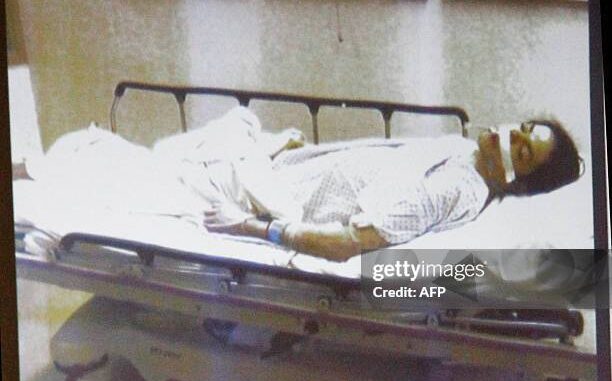
Pop star Michael Jackson lies dead on a gurney as deputy district attorney David Walgren speaks in this evidence photo projection at Dr. Conrad Murray's trial in Jackson's death in Los Angeles on October 5, 2011. AFP PHOTO/Mario Anzuoni/Pool (Photo credit should read MARIO ANZUONI/AFP via Getty Images)
Seventeen years ago, the world lost Michael Jackson, the “King of Pop,” in a tragedy that still feels unreal to many fans. He was 50 years old, weeks away from a massive comeback, when his life ended in a rented mansion in Holmby Hills, Los Angeles.
The Los Angeles County Coroner’s Report ruled his death a homicide. The cause was acute propofol intoxication combined with benzodiazepines, a mix that led to cardiac arrest.
Propofol: A powerful, fast-acting intravenous anesthetic normally used only in hospitals and surgery. Jackson called it his “milk” because of its white, milky look. It was never meant for home use.
Benzodiazepines: The report found significant levels of Lorazepam and Midazolam, plus Diazepam, all given to treat Jackson’s chronic insomnia. Together with propofol, they created a fatal cocktail.
June 24, 2009 – Late Night: Jackson finished a late-night rehearsal at the Staples Center for his “This Is It” London residency. Witnesses said he was energetic and looked great. He got home around 1:00 AM on June 25.
June 25, 2009 – Early Morning: Sleep would not come. Battling severe insomnia, Jackson turned to his personal physician, Dr. Conrad Murray, for help. Through the morning, Murray administered sedatives intravenously.
Late Morning: When the sedatives failed, Jackson reportedly asked for propofol. Murray gave it to him. Jackson finally fell asleep, but within minutes he stopped breathing and went into cardiac arrest.
12:21 PM: After trying CPR and a frantic cleanup of medical vials and equipment, security called 911. The delay became a major point in the later investigation.
2:26 PM: Paramedics rushed Jackson to Ronald Reagan UCLA Medical Center. After extensive resuscitation efforts, he was pronounced dead. News broke worldwide within the hour.
What began as a death inquiry quickly became a criminal case. Prosecutors argued that administering surgical-grade anesthesia in a bedroom without hospital monitoring equipment was gross negligence.
In November 2011, Dr. Conrad Murray was convicted of involuntary manslaughter and sentenced to four years in prison. The court found that his decision to use propofol outside a clinical setting directly caused Jackson’s death.
The courtroom did not tell the full story. Medical and investigative reviews traced Jackson’s drug dependency back to January 27, 1984. While filming a Pepsi commercial, a pyrotechnic effect went wrong and left him with severe third-degree scalp burns. The powerful painkillers prescribed during his recovery started a decades-long struggle with substance use.
By 2009, the pressure had multiplied. Jackson was preparing for 50 sold-out shows in London, a grueling physical and mental demand. Insomnia, pain, and performance anxiety pushed him toward stronger and riskier sleep aids. That desperation, combined with unregulated medical care at home, created the conditions for tragedy.
Michael Jackson died chasing a comeback. Instead, the world got a painful lesson about fame, access to dangerous drugs, and the limits of the human body under pressure. His music, dance, and influence remain untouched by time. But the way he died — alone in a bedroom with a hospital drug — shocked fans and changed how celebrity medical care is scrutinized.
Seventeen years later, the “King of Pop” is remembered for moonwalks and masterpieces. And he is also remembered for a June morning in 2009 when the music stopped too soon…See More









Leave a Reply