Most people associate pyramids with Egypt or Sudan. Few Nigerians know that in the Udi Local Government Area of Enugu State, the Igbo built their own. They were not stone tombs for pharaohs. They were earthen, communal, and spiritual. They were the Nsude Pyramids — also called the Igbo Pyramids — and today they are almost gone.
Colonial anthropologist George Basden recorded the oral account that explains them. According to Nsude tradition, a Dibia, a spiritual guide, received a message that the deity Uto wanted ten large pyramids, known as Nkpura, built in his honor.
The number was not random. Nsude village was made up of ten extended families or quarters. Each family was charged with building one pyramid. It was communal labor tied to spiritual duty.
The structures functioned as temple-like shrines to Ala, the Earth Goddess, and to Uto. At the very top of each pyramid, a stick was planted to mark where the deity was believed to reside. Local elders also say the high ground of the Udi Hills made the pyramids useful as surveillance outposts during regional conflicts, allowing people to spot approaching enemies.
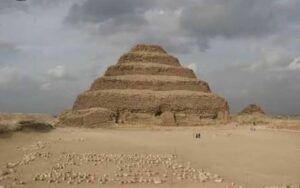
Unlike Egypt’s limestone monuments, Nsude’s were examples of monumental earthen architecture. The builders used local red clay and mud, mixed with water and trampled into a pulp. Some accounts say cow dung was added to bind and harden it. Once dried, the material became surprisingly solid.
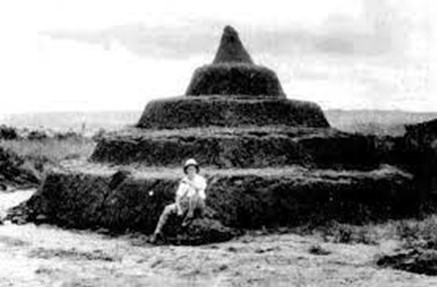
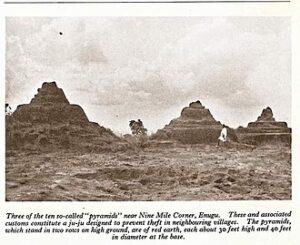
The layout was deliberate. The ten pyramids were arranged in two parallel rows of five. Each base was a circle about 60 feet in circumference and 3 feet high. From there, the builders added successive circular terraces that got smaller as they rose. The second level was about 45 feet around, and the structures tapered upward into stepped cones that reached 19 to 30 feet tall. From a distance, they looked like large grass-covered mounds blending into the hillside.
Because they were made of earth, the pyramids were vulnerable to rain and time. Their best documentation came in 1935, when British anthropologist and colonial officer G.I. Jones traveled through Southeastern Nigeria. Using a Rolleiflex camera, Jones took the only known high-quality black-and-white photographs of the pyramids while they were still standing in full form. Those images remain the primary visual evidence that they existed at all.
The idea that the pyramids are “completely gone” is not entirely true, but their condition is tragic.
Once the religious rites stopped, maintenance stopped too. After colonization and the spread of Christianity, the families that once cared for the Uto shrines no longer had a reason to re-plaster and re-grass the mounds every season. Without that upkeep, tropical rainfall and erosion broke the clay down quickly.
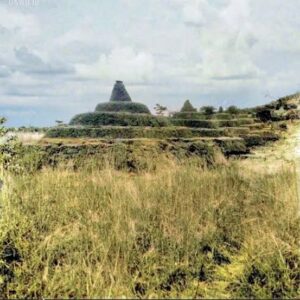
Today, the site is heavily ruined and overgrown. What remains are faint mounds, depressions, and outlines on the Udi hills, often hidden under thick forest foliage. Without a local guide, you would not know you were standing on a pyramid.
Historians and cultural groups now describe the Nsude Pyramids as a major loss to African heritage. They were evidence that pre-colonial Igbo society had sophisticated communal organization, spiritual architecture, and engineering knowledge that did not require stone.
Calls have been made for the Nigerian government to excavate, document, and protect the site for cultural tourism and research. So far, little has been done.
Yes, Igbos also had pyramids. In Nsude, ten earthen shrines rose up to 30 feet, built by ten families for a deity named Uto. They stood for centuries, photographed once by G.I. Jones in 1935, then left to the rain.
The Nsude Pyramids are now mostly earth again. What survives is memory, oral history, and a set of photographs that prove Nigeria’s “lost pyramids” were real…See More





Leave a Reply