History: The Legend Of Perricomo, One Among The Strongest Babalawo In Igbo Land That Police Tried To Arrest But He Disappeared, They Could Only Hear His Voice (Full Details)
In the oral history of Igbo land, the name Chief Pericoma Okoye occupies a rare space where spirituality, culture, music, and folklore meet. To millions in the South-East and beyond, he was more than a traditionalist. He was Arusi Makaja 1, the Lion of Africa, a folk singer, a cultural prime minister, and one of the most talked about Babalawo of his generation.
His life story blends documented achievements with legends that are still told in markets, motor parks, and on social media today. The most popular of them is the famous confrontation at Upper Iweka in Onitsha, a story that turned him from a respected elder into a living myth.
The incident that made Pericoma a household name happened on his way to Onitsha, at the Upper Iweka area. At that time the place was known for violent illegal tax collectors called agbero boys, who harassed travelers and traders for money.
According to accounts passed down in Igbo communities, the extortionists stopped Chief Pericoma and demanded levies. When he refused, they tried to forcefully carry him away, a common way they intimidated people into paying.
Instead of fighting or arguing, Chief Pericoma remained silent. He then made his body impossibly heavy.
The man who tried to lift him collapsed under the weight and could not move. For several hours the tout remained trapped under him. Other members of the group tried to help but could not budge him. Witnesses described it as though the elder had turned to stone.
Realizing they were dealing with spiritual power, the agbero boys reportedly looked for a way to appease him. They brought ritual items and performed rites to his deity. Only after that did Chief Pericoma allow his body to become light again and stepped down.
After that day the story spread fast, and the extortion activities in that area were said to have reduced.
From incidents like this came another popular tale that police once tried to arrest him but he disappeared and they could only hear his voice. There is no official record to confirm a literal police disappearance. The story grew from his wider reputation for avoiding trouble through mystical means. To many, it showed that his power was beyond ordinary.
Chief Pericoma Okoye came from Arondizuogu in Imo State, a town known for its strong traditional heritage. He was a spiritual leader, but also a custodian of Igbo culture.
He held the title Arusi Makaja 1. His fame reached a wider audience in the 1990s when he starred in a biographical Nollywood film about his life alongside veteran actor Pete Edochie. The film gave him the nickname Lion of Africa, and from then even people who never met him knew his name.
His greatest contribution may be in music. Chief Pericoma composed and recorded over 200 tracks in his lifetime. His songs were not only for entertainment. They served as records of Igbo life.
Through his music he preserved Igbo oral history, proverbs, war chants, ancestral praise, and traditional philosophy. He sang about the gods, ancestors, morality, and the dangers of abandoning culture. His instruments were traditional, drums, ogene, and gongs, and his voice carried the tone of an elder speaking to his people.
For many young Igbo people, his albums became one of the few ways to learn about customs that were fading away.
Chief Pericoma Okoye passed away on February 16, 2017. His death was mourned across Igbo land. Traditional rulers, cultural groups, musicians, and ordinary people paid tribute to him.
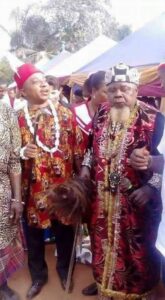
He left behind a large legacy in traditional and cultural preservation. At a time when many were moving away from indigenous practices, Pericoma carried his identity openly. The red cap, the beads, the staff, and the chants were all part of how he lived.
Today his name still comes up in discussions about power, resistance, and culture. The Upper Iweka story is told not only as a tale of mysticism, but as a story of dignity. An elder who refused to be extorted, and who used spiritual authority to defend himself and others.
The legend of Pericoma continues because it speaks to several things.
First, it is about the power of culture. He showed that tradition could still command respect even in a modern city like Onitsha.
It is about resistance. In a society where touts bullied the weak, his story gave people a different example.
it is about preservation. Through more than 200 songs, he ensured that Igbo proverbs, history, and values were documented for the next generation.
Whether people take the stories as literal or symbolic, Chief Pericoma Okoye remains one of the most important figures in recent Igbo history. A Babalawo, a musician, a cultural prime minister, and a man whose voice in song and in legend is still heard today…See_More





Leave a Reply