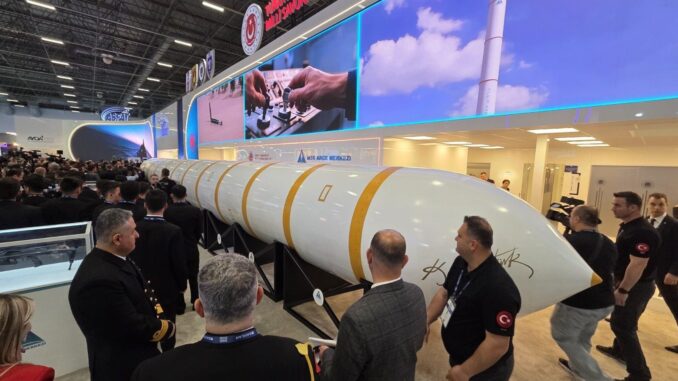
Turkey’s Ministry of National Defense Research and Development center has unveiled what it describes as the country’s first intercontinental ballistic missile prototype, named Yildirimhan, at the SAHA 2026 defense expo in Istanbul.
The missile was presented on May 5, 2026, marking a significant milestone in Ankara’s push to expand its strategic defense capabilities.
The Yildirimhan prototype was displayed as a large white cylindrical rocket with yellow bands, drawing attention from defense analysts and expo attendees.
According to information released at the event, the missile has a reported range of 6,000 kilometers and is capable of reaching speeds between Mach 9 and Mach 25 during different phases of flight.
Officials indicated that the missile uses four liquid-fuel engines powered by Nitrogen Tetroxide propellant and is designed to carry a payload of up to 3,000 kilograms.
If the specifications are confirmed through testing, the range would place the system within the lower tier of intercontinental ballistic missiles, significantly extending Turkey’s strike reach beyond its immediate region.
From Turkish territory, a 6,000-kilometer range would theoretically allow coverage of much of Europe, parts of Asia and large sections of the Middle East. Such capability represents a notable expansion compared to Turkey’s existing missile systems, which have traditionally been classified as short- to medium-range.
While the unveiling marks a technological statement, it remains a prototype. No official timeline for full operational deployment was disclosed during the expo.
Defense observers note that ICBM development involves extensive testing, including multiple flight trials, re-entry vehicle validation and guidance accuracy assessments before any system becomes fully operational.
Turkey has in recent years invested heavily in domestic defense production, including drones, naval platforms and missile systems, as part of a broader strategy aimed at reducing reliance on foreign suppliers.
The introduction of the Yildirimhan prototype fits into Ankara’s long-standing emphasis on strategic self-reliance in critical defense technologies.
The display at SAHA 2026 also carries geopolitical implications. Expanding long-range missile capability can serve as a deterrence signal, especially in a region marked by complex security dynamics and shifting alliances.
Analysts caution, however, that the political and strategic consequences of fielding such systems depend not only on technical capability but also on doctrine, transparency and international agreements….See More







Leave a Reply