Senate President Godswill Akpabio has stated that Nigerians once offered to pay up to ten thousand naira per litre for fuel when it was unavailable, framing the remark as context for current prices and availability following the removal of fuel subsidies.
The statement, made while praising President Bola Tinubu’s policies, has triggered strong backlash from Nigerians who view the comment as insensitive, dismissive of economic hardship, and evidence that political leaders are out of touch with the struggles that ordinary citizens face as fuel prices continue to climb and inflation erodes purchasing power.
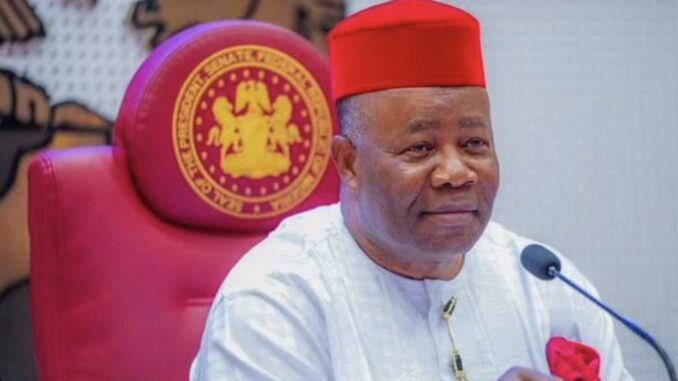
The post, shared by Instablog9ja and accompanied by a photo of Akpabio in formal attire, has drawn thousands of replies, the vast majority of them critical and many of them expressing disbelief that a Senate President would use desperation as justification for high prices.
The context Akpabio is referencing is the period of severe fuel scarcity that Nigeria experienced during previous administrations, when supply disruptions, distribution failures, and hoarding created situations where petrol was unavailable at official prices and black market vendors charged multiples of the pump price.
In those moments of desperation, some Nigerians, particularly those who needed fuel for generators, transportation, or business operations, were willing to pay inflated prices to secure supply. Akpabio’s point appears to be that current prices, while high, are lower than the black market rates people were willing to pay during scarcity, and that the removal of subsidies has at least ensured availability even if it has also raised costs.
The problem with the argument is that it equates crisis pricing during scarcity with acceptable pricing during relative availability.
The fact that people were willing to pay ten thousand naira per litre when there was no other option does not mean that they can afford to pay current prices or that those prices are fair, sustainable, or in the best interest of the population.
Desperation is not consent, and using it as a benchmark for policy success is both morally and economically problematic.
Reactions to Akpabio’s statement were overwhelmingly negative. Users accused him of being tone-deaf, callous, and disconnected from the reality of life for the majority of Nigerians who are struggling to afford food, rent, and transportation in an economy where fuel price increases have cascaded into every sector.
The phrase “read the room” appeared in multiple replies, reflecting a sentiment that Akpabio’s attempt to defend high fuel prices by referencing even higher black market prices during scarcity is not the political win he seems to think it is.
Many commenters pointed out that the willingness to pay ten thousand naira per litre during scarcity was not a preference or a market signal that high prices are acceptable.
It was an act of desperation by people who had no choice, who needed fuel to keep their businesses running or to get to work, and who were being exploited by vendors who took advantage of supply failures. Using that desperation as a defence of current policy is not an argument. It is an insult.
Others noted that Akpabio and other political elites do not buy their own fuel, do not pay for their own transportation, and do not experience the economic pain that subsidy removal has caused.
They travel in government vehicles fueled at government expense, live in accommodations where power and water are provided, and earn salaries and allowances that insulate them from the cost-of-living increases that are crushing ordinary households. From that position of privilege, it is easy to tell Nigerians that they should be grateful that fuel is available at current prices because it used to be worse.
From the position of someone earning minimum wage or less, the statement is not just insensitive. It is evidence that the people making policy decisions have no idea what those decisions cost….See More



Leave a Reply