Between July 6, 1967 and January 15, 1970, Nigeria was torn apart by a war that remains one of the most painful chapters in African history.
The conflict pitted the Federal Military Government against the self-declared Republic of Biafra in the southeast. What began as a political crisis ended as a humanitarian tragedy that claimed between 1 million and 3 million lives, with the vast majority dying from starvation and disease rather than combat.
The roots of the war lay in Nigeria’s colonial foundation. In 1914, Britain merged the Northern and Southern protectorates for administrative convenience, bringing together more than 250 ethnic groups with different cultures, religions, and systems of government.
The country was structured into three regions, with the North given a larger population and therefore greater political weight. Over time, the South embraced Western education and Christianity while the North retained its Islamic emirate system. By independence in 1960, the gap in literacy, civil service representation, and economic opportunity had become a source of tension.
That tension exploded in 1966. On January 15, junior army officers, many of them Igbo, overthrew the civilian government and killed several prominent Northern and Western leaders. Major General Aguiyi-Ironsi took power and later abolished the federal structure in favor of a unitary state. To many Northerners, this looked like a move toward Southern domination. Six months later, Northern officers launched a counter-coup, killed Ironsi, and installed Lt. Col. Yakubu Gowon as Head of State.
What followed were months of coordinated violence against Igbo civilians in the North. Between June and October 1966, an estimated 30,000 Igbo were killed and more than 1 million fled to the Eastern Region. Lt. Col. Odumegwu Ojukwu, the military governor of the East, argued that the federal government could no longer guarantee the safety of its citizens. After reconciliation talks in Aburi, Ghana collapsed, Ojukwu announced the secession of the Eastern Region and the creation of the Republic of Biafra on May 30, 1967.
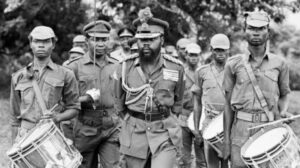
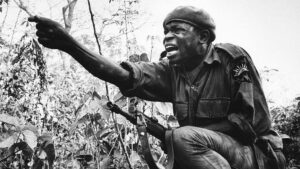
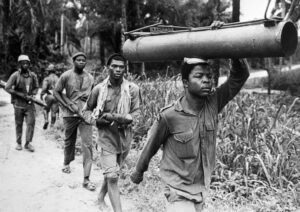
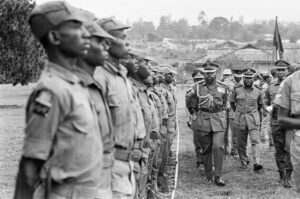
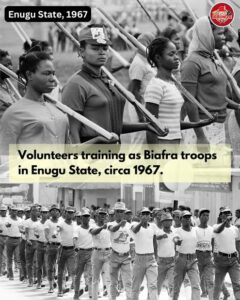
The war began on July 6, 1967. Nigeria had a larger, better equipped army with access to foreign weapons, money, and international support. Biafra started with fewer than 1,000 professional soldiers and grew to about 60,000 through conscription and volunteers. Cut off from regular supply lines, Biafran engineers built their own weapons, including the Ogbunigwe, a homemade bomb that became a symbol of their determination to survive with limited resources.
The early months saw Biafran forces cross the Niger River and briefly hold parts of the Mid-West. But federal troops quickly pushed them back. In October 1967, Enugu, the Biafran capital, fell. In May 1968, Port Harcourt, the oil-rich coastal city, was captured. That cut Biafra off from the sea and from the outside world. From that point, the enclave was surrounded and dependent on airlifts for survival.
The war was never just a Nigerian affair. Britain backed the federal government to protect Shell-BP oil investments and maintain crude supply during Middle East disruptions. The Soviet Union also supported Nigeria, providing fighter jets and bombers. France quietly supplied Biafra through neighboring states, hoping to weaken a British-aligned Nigeria and secure future oil access. The United States stayed officially neutral, refusing to sell arms but providing humanitarian assistance.
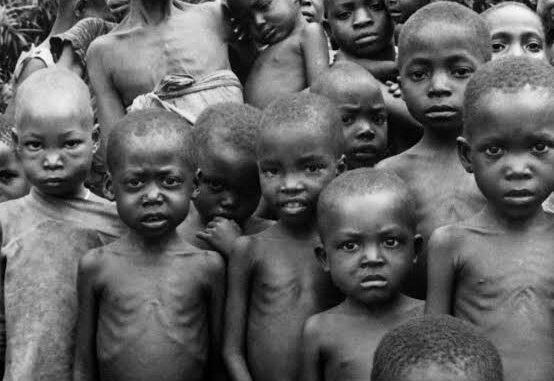
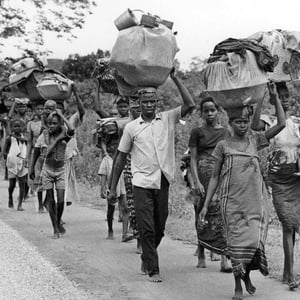
The defining feature of the war was the blockade. The federal government sealed Biafra by land, sea, and air. Food, medicine, and fuel could not enter. Chief Obafemi Awolowo, then federal minister of finance, publicly described starvation as a legitimate weapon of war. Inside Biafra, children suffered from kwashiorkor and other forms of severe malnutrition. For the first time, a major African conflict was broadcast on television. Graphic images of starving children shocked viewers worldwide and led to the formation of Doctors Without Borders and the Joint Church Airlift, which ran dangerous night flights to deliver food.
By late 1969, Biafra had been reduced to a small pocket of territory. In January 1970, the final capital, Umuahia, fell. Ojukwu fled to Côte d’Ivoire on January 10. Five days later, his deputy, Major General Philip Effiong, surrendered to General Gowon in Lagos.
After the war, Gowon declared a policy of “No Victor, No Vanquished” and launched a program of Reconciliation, Reconstruction, and Rehabilitation. In practice, many Igbo felt excluded. Biafran currency was declared worthless and citizens were given a flat payment of £20 regardless of previous wealth. Properties abandoned during the war were often taken over and not returned.
The Nigeria-Biafra war ended after 30 months, but its impact did not. It exposed the fragility of a nation built on colonial borders. It showed how oil, ethnicity, and politics could be weaponized. And it showed the resilience of a people who, with minimal support, built factories, made weapons, and held out against a much larger state.
Today, the war is still not taught in full detail in many Nigerian classrooms. Yet understanding it is essential. It helps explain current conversations about unity, equity, and memory in Nigeria, and it reminds us that the true cost of war is always paid by civilians…See_More



Leave a Reply