

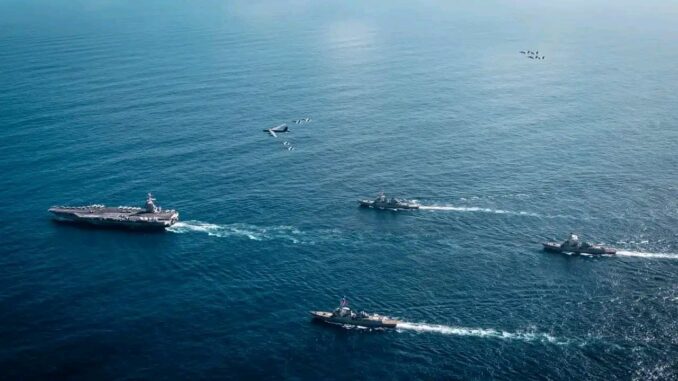
According to a report by The Jerusalem Post on Sunday, Jan. 25, 2026, the United States may choose to impose a blockade on Iran rather than launch a direct military strike, according to Danny Citrinowicz, a senior researcher and Iran expert at the Institute for National Security Studies (INSS). He shared this assessment during a Sunday interview with 103FM, emphasizing that the current US military buildup in the region does not necessarily indicate an imminent kinetic attack.
Citrinowicz’s comments follow US President Donald Trump’s confirmation last week that “a lot of ships” were heading towards Iran, though he expressed hope that military force would not be necessary. “We have an armada heading their way. They know what we want,” Trump said during his appearance at the World Economic Forum in Davos.
“The American presence in the Gulf provides operational flexibility,” Citrinowicz noted, “which means the US could pursue a blockade instead of a direct strike. Israel must also consider that all options remain on the table.” He added that while Israel has given the US the lead in any potential action, it remains unclear what Washington’s ultimate strategic objective is, particularly given the contradictions in the President’s public statements.
Supporting this perspective, former national security adviser Dr. Eyal Hulata told 103FM that despite the heightened American military presence, the current situation does not point to an immediate large-scale war. “It is possible that US pressure could bring Iranian leaders to the negotiating table without a direct attack,” Hulata said, suggesting that Trump may prefer diplomacy over military escalation.
Both Citrinowicz and Hulata stressed that an Iranian response targeting Israel is not guaranteed, even if the US takes action. Citrinowicz explained that if Iran views a potential American strike as symbolic rather than aimed at regime change, it may not retaliate against Israel. However, if Iran believes the US intends to topple its leadership, it could consider attacking Israel to halt the offensive.
Hulata warned that any Iranian strike on Israel would likely provoke a strong response, targeting critical infrastructure vital to Iran’s economy and regime stability. He advised that Israel should refrain from initiating military action unless absolutely necessary, noting that Israeli operations would be carried out with fewer restraints than those of the United States.
Regarding civilian preparedness, Hulata urged the Israeli public to trust the Home Front Command, assuring that security agencies would take measured precautions to protect civilians. “The command and security establishment will avoid unnecessary risks, ensuring that people are within protected areas and prepared for any contingency,” he stated.
If you love political news or like to get more news happening around the globe, use the button below to get more verified news happening around Nigeria and the world today.


Leave a Reply