Tucker Carlson has stated that “Muslims love Jesus,” noting Islamic belief in Jesus as a major prophet, a performer of miracles, and a figure who will return in the future to defeat the Antichrist, a statement that has triggered widespread discussion about the theological common ground and profound differences between Christianity and Islam.
The claim, shared by BRICSinfo, was tied to a controversy involving Iran’s president condemning a painting by President Trump as a “desecration of Jesus,” which Tucker framed as evidence that Muslims take reverence for Jesus seriously and that the offense was understood as an affront to both Islam and Christianity.
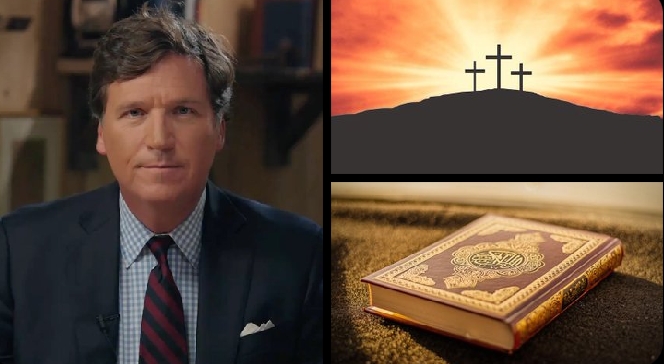
The post included images of Tucker Carlson, three crosses at sunset, and a Quran, visual elements designed to amplify the conversation about shared reverence for Jesus amid the differing doctrines on his divinity, his death, and his role in salvation.
The statement is technically accurate but theologically incomplete, which is why it has generated both agreement and pushback. Islam does revere Jesus, known in Arabic as Isa, as one of the greatest prophets sent by God. The Quran describes his virgin birth, his miracles including healing the sick and raising the dead, and his role as a messenger who called people to worship the one true God.
Islamic eschatology teaches that Jesus will return before the Day of Judgment, defeat the Antichrist, known in Islam as al-Masih ad-Dajjal, and establish justice on earth. In that sense, Muslims do “love” Jesus in the way that they love and honour all prophets, and they view disrespect toward him as blasphemy.
The critical difference, and the reason Tucker’s statement is generating debate, is that Islam does not accept the central tenets of Christianity regarding Jesus. Muslims do not believe that Jesus is the Son of God, that he is part of a Trinity, or that he was crucified and resurrected.
The Quran explicitly rejects the idea that Jesus was divine and teaches that he was a human prophet, that he was not killed on the cross but was raised to heaven by God, and that he will return not as a saviour who died for sins but as a prophet who will correct false beliefs and lead humanity back to the worship of God alone.
Those differences are not minor theological details. They are foundational, and they define the boundaries between two religions that share some common narratives but arrive at fundamentally incompatible conclusions about who Jesus is and what his life and mission mean.
Tucker’s framing, which emphasises shared reverence, is appealing in a context where Islam and Christianity are often portrayed as opposed or in conflict, particularly in political and media discourse that focuses on terrorism, extremism, or cultural clashes. The idea that Muslims and Christians both love Jesus creates a sense of common ground and can be used to argue for dialogue, mutual respect, or cooperation on moral and social issues. But the framing also risks oversimplifying the theological divide and creating the impression that the differences are smaller or less significant than they actually are…See More







Leave a Reply