
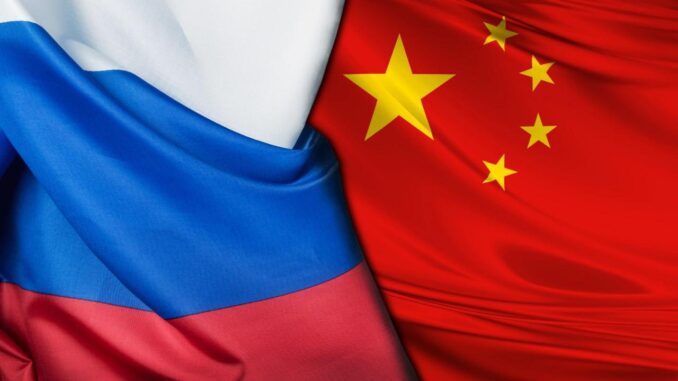
Russia and China have declared they will no longer use the US dollar in any bilateral trade transactions between their countries, according to reports circulating on social media platforms. The announcement, accompanied by imagery of intertwined Russian and Chinese flags, represents the formal completion of a de-dollarization process that has been underway for several years and has accelerated dramatically since Western sanctions on Russia intensified following the 2022 Ukraine invasion. Russian officials recently confirmed that between 90% and 95% or more of trade between the two nations is already being settled in rubles and yuan rather than dollars, making the formal declaration largely a recognition of existing reality rather than a sudden shift in practice.
The move toward complete elimination of dollar-denominated trade between Russia and China reflects both strategic geopolitical calculations and practical necessity.
For Russia, continuing to use the US dollar for international transactions became increasingly risky and often impossible after Western sanctions cut Russian banks off from the SWIFT international payment system and froze hundreds of billions of dollars in Russian foreign reserves.
These measures demonstrated to Moscow that reliance on dollar-based financial infrastructure meant vulnerability to Western economic warfare, creating powerful incentives to develop alternative payment mechanisms that could not be disrupted by Washington or its allies.
For China, supporting Russia’s de-dollarization serves multiple strategic objectives. It strengthens the bilateral relationship with Russia at a time when both nations see themselves in strategic competition with the United States and its allies.
It provides practical experience and infrastructure development for yuan-based international trade that could eventually expand to other trading partners. Additionally, it reduces China’s own vulnerability to potential future sanctions by demonstrating that major economies can conduct substantial trade without dollar involvement, potentially weakening the effectiveness of sanctions as a tool of American foreign policy.
Russian officials have been openly discussing the advanced state of de-dollarization in trade with China for months.
In recent statements, senior Russian economic and financial authorities confirmed that the overwhelming majority of bilateral trade is now conducted in rubles and yuan, with the dollar having been almost entirely eliminated from Russia-China commerce.
This transition was achieved through a combination of direct currency exchange mechanisms, expansion of ruble and yuan payment infrastructure, currency swap agreements between the Russian and Chinese central banks, and simple necessity as sanctions made dollar transactions impractical or impossible for many Russian entities.
The practical infrastructure supporting ruble-yuan trade has developed rapidly. Russian and Chinese banks have established direct correspondent relationships that allow settlement in national currencies without routing through dollar-based clearing systems.
The two countries have connected their domestic payment systems, allowing Russian Mir cards to work in China and Chinese UnionPay cards to work in Russia.
Chinese and Russian companies have adapted their accounting and payment systems to handle bilateral trade in rubles and yuan.
This infrastructure development represents significant investment and adjustment but creates a foundation that could potentially be expanded to include other countries seeking to reduce dollar dependence.
Trade between Russia and China has grown substantially even as Russia’s trade with Western nations has collapsed under sanctions. China has become Russia’s largest trading partner by far, purchasing Russian energy, raw materials, and agricultural products while selling manufactured goods, technology, and consumer products to Russia.
This trade relationship, now conducted almost entirely in national currencies, demonstrates that major economies can sustain substantial commercial relationships outside the dollar system, challenging assumptions that have underpinned global finance for decades.
However, it is important to contextualize the Russia-China de-dollarization within the broader global financial system. While the elimination of the dollar from bilateral trade between two major economies is significant symbolically and strategically, the US dollar remains overwhelmingly dominant in international finance overall.
The dollar accounts for approximately 60% of global foreign exchange reserves, despite gradual declines in recent years. It dominates international payment systems, with the majority of cross-border transactions globally still denominated in dollars. Major commodities, particularly oil, are still primarily priced and traded in dollars, though this too is gradually changing in some markets…See More





Leave a Reply