
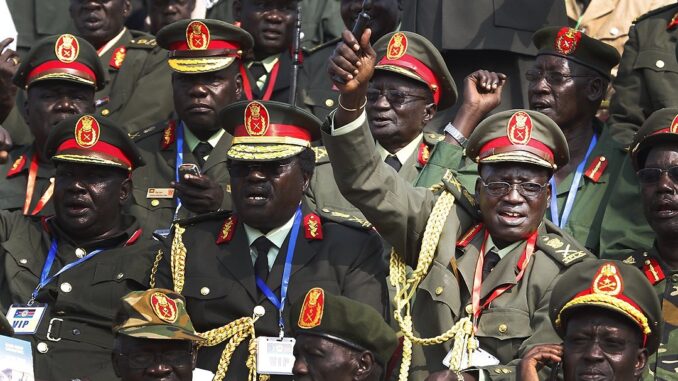
South Sudan, which gained independence in 2011 after decades of conflict, has approximately seven hundred and forty-five generals serving in its military, a number that dwarfs the estimated four hundred to five hundred doctors available to serve a population of roughly eleven million people.
The disparity, highlighted in a post accompanied by an image of a large assembly of high-ranking officers, underscores the consequences of prolonged war and the challenges of building a functional state in a post-conflict environment where military structures were prioritised over civilian institutions including healthcare, education, and governance.
The high number of generals is not the result of a carefully designed military hierarchy. It is the product of a peace process that integrated fighters from multiple armed groups into a single national army in an effort to maintain stability and prevent the resumption of civil war.
Each faction brought its own commanders, and those commanders were given ranks that reflected their status and influence within their respective groups. The result is a top-heavy military where the ratio of generals to soldiers is absurdly high and where command structures are more political than functional, designed to accommodate former warlords and militia leaders rather than to create an effective fighting force.
The lack of doctors, by contrast, reflects decades of underinvestment in healthcare infrastructure, the destruction of medical facilities during the wars that preceded and followed independence, and the exodus of trained professionals who fled the country in search of safety and better opportunities. South Sudan’s physician density, approximately zero point zero four doctors per one thousand people as of around 2020, is among the lowest in the world. For comparison, Nigeria, which itself faces severe healthcare shortages, has roughly four times that density. The gap between what South Sudan has and what it needs is measured not in increments but in orders of magnitude.
The statistic, seven hundred and forty-five generals versus four hundred doctors, is a metric of state failure. It tells the story of a country that emerged from war but never transitioned to peace, where the institutions of violence were preserved and expanded while the institutions of care and development were neglected or ignored. It reflects a political system where power is held by men with guns and where the skills and professions that build societies, medicine, teaching, engineering, law, are undervalued and underfunded….See More



Leave a Reply