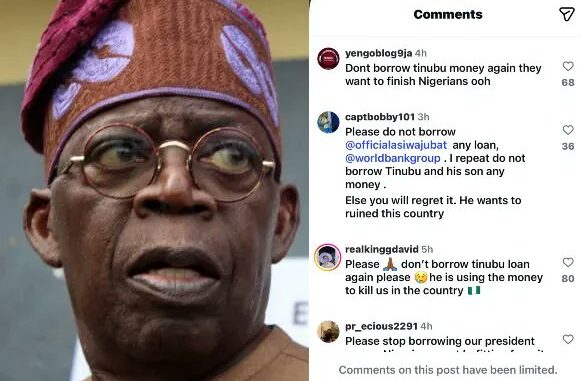
Nigerians have flooded the World Bank’s social media channels with furious comments and pleas to reject a proposed $1.25 billion loan to the Tinubu administration.
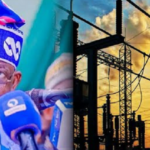
The outpouring, visible in screenshots of comment threads paired with President Tinubu’s portrait, reflects deepening frustration as the country grapples with soaring debt, collapsing purchasing power, and the absence of tangible infrastructure gains from earlier borrowings.
The facility, titled Nigeria Actions for Investment and Jobs Acceleration, is the second-largest World Bank loan under Tinubu after a $1.5 billion package approved in 2024.
It is scheduled for board review on June 26, 2026, and is framed by Abuja as a catalyst for reforms across electricity, agriculture, trade, and job creation. Proponents inside the government argue the funds are essential to unlock private-sector investment and break a decade-long stagnation.
Yet the message from ordinary Nigerians is clear. The country cannot afford another round of borrowing.
Public debt has swollen to more than ₦160 trillion, roughly $120 billion at current rates, while Nigeria already owes the World Bank $19.89 billion.
Every new loan, citizens argue, deepens a repayment burden that crowds out spending on health, education, and basic services. Inflation, which hovers just above 28 percent, has eroded wages, while electricity blackouts and failed road projects remain daily realities in cities and villages alike.
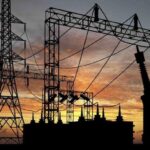
The loan’s intended sectors, electricity, agriculture, trade, and jobs, are exactly the areas where citizens say past loans have failed to deliver.
Power plants built with earlier financing still trip frequently. Farms promised fertiliser and credit remain under-funded. Trade corridors meant to connect ports to markets sit blocked by poor roads and customs bottlenecks. Social media posts repeat the same refrain. We have borrowed enough. Show us the roads, the lights, the jobs, not just spreadsheets.
Direct voices from the comment threads capture this mood. One user wrote, “We are not against development. We are against borrowing to pay old debt while schools lack teachers and hospitals lack drugs.” Another added, “Every dollar borrowed today is a naira taken from a mother buying medicine for her child tomorrow.” A third, a small-scale farmer in Kano, posted, “This loan will not bring rain to our fields, only more interest to pay.”
These remarks echo a wider narrative across Nigeria’s cities and rural hamlets. Distrust in how borrowed funds are allocated and suspicion that elite interests, rather than public need, shape loan terms. Civil society groups have amplified the social media wave, organising petitions and live-streamed briefings to pressure both the World Bank and Abuja. Their brief context is simple. Nigeria’s debt trajectory is unsustainable, and without structural reform before new money arrives, the next loan will merely extend a cycle of crisis.
Reactions on and off social media have been swift. Young professionals in Lagos describe the loan as a gamble with our futures. Traders in Port Harcourt call it a tax on survival. Even some economists, speaking anonymously for fear of government reprisal, acknowledge that the country’s fiscal space is too thin to absorb another $1.25 billion without deep, visible austerity and transparency measures.
For now, the debate is locked at the World Bank’s board table, with the June 26 vote looming. Nigerians’ digital protest, raw, personal, and unfiltered, has become more than noise. It is a demand for accountability. They are no longer asking whether the loan can be funded. They are demanding proof that the money, when finally spent, will land where it hurts least. In people’s lives, not balance sheets.
The outcome of the June review will be watched not only by financiers but by every citizen whose daily struggle, paying bills, feeding families, or waiting for power, hangs in the balance….See More


Leave a Reply