
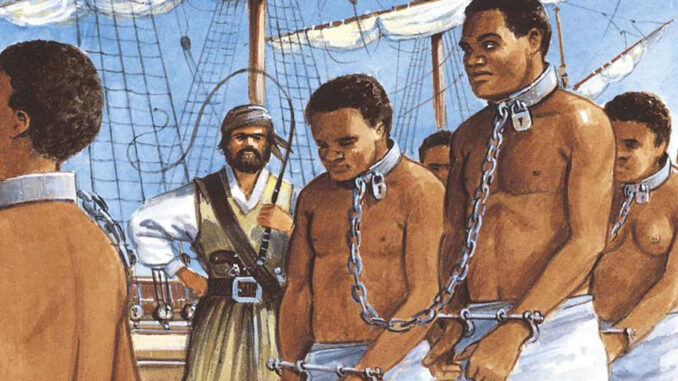
When the slave trade is discussed in classrooms, the focus is usually on the transatlantic trade to the Americas. But there was another system that started earlier, lasted longer, and moved millions of people. It is the Arab slave trade.
For roughly 13 centuries, from about 650 AD into the 20th century, African men, women, and children were forced across the Sahara Desert and the Indian Ocean into the Middle East, North Africa, and parts of Asia. Estimates range from 10 to 17 million people displaced. That is a number equal to entire nations today.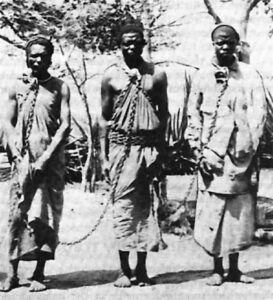
Historical Scope and Justification
The Arab slave trade predated the transatlantic trade by hundreds of years. It did not end with European abolition. It continued in some places well into the 1900s.
The demand was different. Instead of large plantations, the main buyers were households, armies, and royal courts. People were wanted as domestic workers, soldiers, laborers, and administrators. Because the work was inside homes and palaces, the selection process was often more invasive and more brutal.
This system was also given intellectual backing. Scholars and jurists wrote texts that were used to justify the enslavement of Africans. The works of historians like Ibn Khaldun were quoted to describe Africans in dehumanizing terms. Religious language was mixed with race ideas to make the trade seem normal and permanent. That made it harder for captives and later activists to challenge.
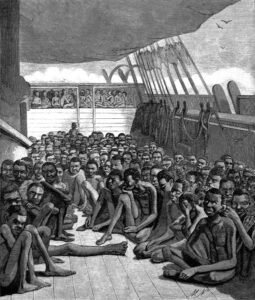
One of the most disturbing features was the mass castration of African boys and men. The goal was to produce eunuchs for service in elite households and to guard harems. Eunuchs were valued because they were seen as loyal and unable to start families that could challenge their owners.
To meet demand, specialized centers were set up along trade routes, especially in East Africa and North Africa. The procedures were done without medicine, without care, and under terrible conditions.
Contemporary accounts and later historians report mortality rates as high as 90 percent. For every 10 boys operated on, only 1 or 2 might survive. Those who lived faced lifelong health problems.
Castration was also a tool of population control. By stopping enslaved men from having children, Arab elites tried to prevent the growth of a large African diaspora in their lands. The result was generations of lost families and lost communities.
The trip across the Sahara was itself a death sentence for many. Caravans walked for weeks with little water. People were chained to keep them from running. Disease, starvation, and violence killed thousands along the way.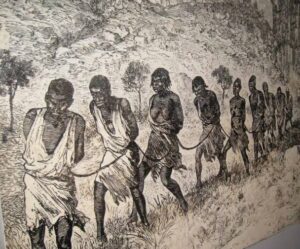
Those who survived the desert were then shipped across the Red Sea or Indian Ocean to places like Saudi Arabia, Iraq, Iran, Oman, India, and even China. Families were split. Names were changed. Records were not kept.
Most Arab countries officially abolished slavery by the late 20th century. But laws did not end the practice everywhere.
Mauritania is the most cited example. Slavery was only legally abolished there in 1981, and it was criminalized much later in 2007. Yet human rights organizations report that hereditary slavery continues, mainly affecting the Haratine and Afro-Mauritanian communities. Children are still born into bondage to families who claim ownership over them.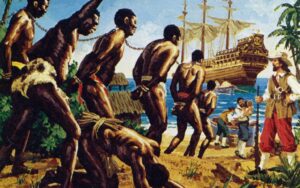
Activists inside and outside Mauritania continue to push for enforcement, education, and reparations. International pressure has helped, but the problem has not disappeared.
There are few museums, few memorial days, and few school lessons about the Arab slave trade compared to the transatlantic trade. That silence has consequences.
Without memory, there is no accountability. Without accountability, modern forms of forced labor and trafficking are easier to ignore. The descendants of those taken still live in the Middle East and North Africa today. Many face discrimination and are still fighting for recognition.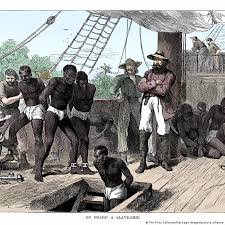
The goal is not to create a competition of suffering. The goal is to tell the full story. Ten to seventeen million people were taken. Hundreds of thousands were castrated. Entire communities were erased from the Sahara routes.
The Arab slave trade was long, systematic, and devastating. It used religion, scholarship, and economics to justify itself. It used the desert and the sea to hide its crimes. And in some places, its shadow is still present.
Things school did not teach you deserve to be said out loud now. Remembering the victims is not about blame. It is about truth. And truth is the only way to make sure this never happens again…See_More



Leave a Reply