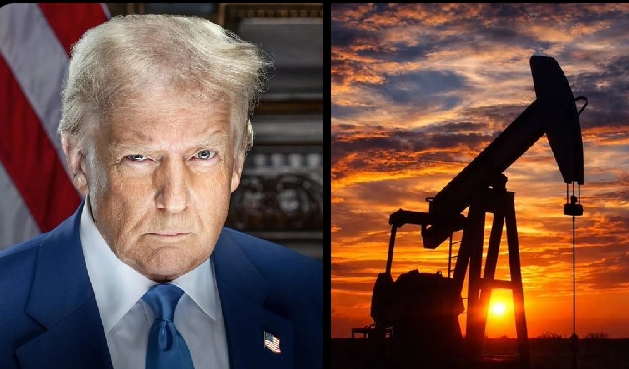
President Donald Trump has publicly criticised the United Kingdom for not developing its North Sea oil fields, calling them “one of the greatest fields in the world” and urging the country to adopt a “drill, baby, drill” approach while opposing the construction of more windmills.
The comments, made through social media and reported widely across international outlets, highlight tensions between Trump’s vision of energy independence built on fossil fuel extraction and the UK’s Labour government priorities, which include a transition to net-zero emissions, expanded renewable energy capacity, and reduced reliance on oil and gas.
The statement also comes at a moment when European energy prices are elevated due to Middle East supply disruptions and when the question of how to balance energy security with climate commitments is politically contentious across the continent.
The problem with Trump’s advice is that the North Sea is not an untapped resource waiting to be developed. It is a mature oil and gas basin where production has been ongoing since the 1970s and where roughly ninety percent of the estimated ultimate recoverable oil and gas has already been extracted.
The UK currently has approximately two point nine billion barrels of oil equivalent in proven reserves, with additional contingent resources that may or may not be economically viable to extract depending on prices, technology, and regulatory environment. The North Sea was once one of the world’s most productive oil regions, but it is now in decline, and the remaining reserves are harder to access, more expensive to produce, and located in fields that require significant investment to maintain or extend production.
The call to “drill, baby, drill” assumes that the UK is choosing not to develop resources that are readily available and profitable, when the reality is that the North Sea’s decline is driven by geology and economics rather than political opposition to drilling. The UK does continue to produce oil and gas from the North Sea, but the output has been falling for decades, and the investments required to slow that decline are increasingly difficult to justify when global markets are volatile, when climate regulations are tightening, and when the long-term future of fossil fuels is uncertain.
Trump’s opposition to windmills, a term he uses to refer to wind turbines, reflects his broader scepticism about renewable energy and his belief that wind power is inefficient, unreliable, and a waste of resources that should be invested in oil and gas infrastructure. The UK, by contrast, has invested heavily in offshore wind and is one of the world leaders in wind energy capacity, with plans to expand further as part of its commitment to reach net-zero emissions by 2050.
Wind power now accounts for a significant share of UK electricity generation, and the industry supports tens of thousands of jobs and billions of pounds in investment.
The clash between Trump’s energy vision and the UK’s climate priorities is not just about policy. It is about worldview. Trump sees energy independence as a matter of extracting and using domestic fossil fuels to reduce reliance on foreign suppliers and to keep energy prices low for consumers and industry. The UK Labour government sees energy independence as a matter of transitioning away from fossil fuels entirely, building renewable capacity that does not depend on volatile global oil and gas markets, and positioning the country as a leader in the clean energy economy that is expected to dominate the second half of the century.
Reactions to Trump’s comments were divided along predictable lines. Supporters of his position argued that the UK is making a mistake by prioritising renewables over oil and gas, that wind power cannot provide the reliable baseload energy that modern economies need, and that the decline of North Sea production is the result of political decisions rather than geological realities.
They framed Trump’s advice as common sense and accused the UK government of sacrificing energy security and economic growth to pursue climate goals that will not be matched by other major economies…See More




Leave a Reply