
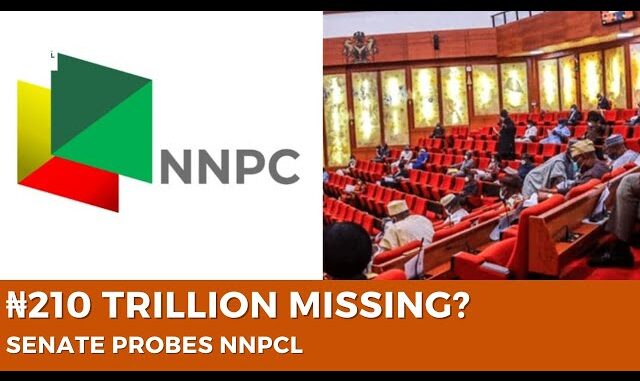
Nigeria is once again confronting a financial scandal of extraordinary proportions following revelations that approximately 210 trillion naira, roughly 150 billion dollars, in revenue generated by the Nigerian National Petroleum Company Limited between 2015 and 2022 remains unaccounted for. The figure emerged from Senate audit processes that began in July 2025, and the Socio-Economic Rights and Accountability Project has since demanded that Senate President Godswill Akpabio compel the disclosure of the names of officials responsible. But for many Nigerians, the scandal is not shocking. It is simply the latest and largest entry in a long history of public funds disappearing under circumstances that range from suspicious to outright absurd.
To understand why Nigerians greet each new corruption revelation with a mixture of rage and dark humour, one must revisit some of the most infamous episodes in the country’s recent past. In 2018, a clerk at the Joint Admission and Matriculation Board, JAMB, claimed that a snake had swallowed 36 million naira from a vault in the agency’s office in Makurdi, Benue State. The story was reported with a straight face by officials before public ridicule forced a closer examination of the claim. The money had not been swallowed by a snake. It had been stolen by human beings. But the excuse entered Nigerian folklore as a symbol of how brazenly public officials treat the intelligence of the citizens they serve.
That same year, reports emerged from the National Directorate of Employment that monkeys had invaded the agency’s office in the north and made away with millions of naira. The claim followed a similar pattern. An outrageous explanation was offered for missing funds, the public reacted with disbelief, and no meaningful consequence followed. Around the same period, a separate case involved allegations that rats had eaten large sums of money stored in a government office. Each incident followed the same script. Money went missing, an explanation was offered that insulted common sense, and the matter quietly disappeared from official attention.
No official was ever meaningfully held to account in any of these cases, a pattern that has repeated itself across every level of government and every administration.
The 210 trillion naira NNPCL scandal operates on an entirely different scale, but the underlying mechanics are familiar. Public funds are generated, records are poorly maintained or deliberately obscured, discrepancies are discovered years after the fact, and when questions are finally asked, the answers are either absent or designed to delay accountability indefinitely. NNPCL has disputed characterisations of the missing revenue as theft, arguing instead that the figures require reconciliation. For ordinary Nigerians, reconciliation has become the bureaucratic equivalent of blaming a snake. It sounds technical enough to buy time but explains nothing about where the money actually went.
The difference between a snake allegedly swallowing 36 million naira and 210 trillion naira vanishing from the books of the country’s most important revenue-generating entity is one of scale, not character. In both cases, the fundamental problem is the same. Public money disappears, nobody is named, nobody is prosecuted, and citizens are left to absorb the consequences through crumbling infrastructure, underfunded hospitals, overcrowded classrooms, and an economy that never seems to have enough money for the things that matter despite generating enormous wealth on paper.
SERAP’s demand for the names of officials linked to the NNPCL discrepancies is significant precisely because naming is the step that Nigeria’s accountability process almost never reaches. Audit reports are produced, committees are formed, hearings are held, and findings are announced. But the names of those responsible are either withheld, redacted, or buried in recommendations that no one acts on. The result is a system where corruption is constantly discovered but never punished, and where every new scandal is eventually overtaken by the next one before consequences can take root….See More





Leave a Reply