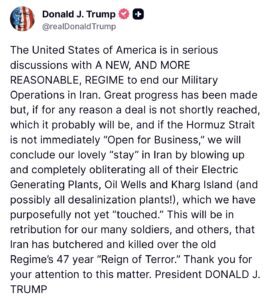
President Donald Trump has issued a sweeping threat against Iran, warning that the United States will destroy the country’s electric plants, oil wells, Kharg Island, and possibly its desalination facilities if a deal is not reached soon. The statement, posted on Truth Social, came alongside an announcement that Washington is negotiating with what Trump described as a new and more reasonable Iranian regime. He framed the threats as retribution for past Iranian actions against American personnel while demanding the reopening of the Strait of Hormuz.
The statement carries enormous weight. Kharg Island alone handles roughly ninety percent of Iran’s crude oil exports. Destroying it would not only cripple the Iranian economy but send shockwaves through global energy markets. The Strait of Hormuz, through which approximately twenty percent of the world’s oil supply passes daily, has been a flashpoint in the standoff between both nations. Any sustained disruption to that waterway would trigger price spikes that reach every oil-importing and oil-exporting nation, Nigeria included.
What alarmed observers most was the mention of desalination facilities. According to World Bank data, approximately seventy percent of Iran’s potable water is sourced through desalination, serving a population of over ninety million people. Targeting water infrastructure would move the conflict from military and economic confrontation into the territory of a humanitarian catastrophe. Access to clean water is protected under international humanitarian law, and deliberately destroying the systems that provide it to a civilian population would draw condemnation from virtually every international body and human rights organisation on record.
Trump’s language left little room for ambiguity. He presented the situation as a binary choice for Tehran. Negotiate on American terms or watch critical national infrastructure be reduced to rubble. The tone was consistent with his broader approach to foreign policy, one built on maximum pressure, visible threats, and a willingness to escalate that supporters view as strength and critics view as recklessness.
The statement referenced what appears to be an escalated American military presence in or near Iran, suggesting that the situation on the ground may have moved well beyond diplomatic posturing. Whether this reflects regime change, occupation, or a forward military positioning remains unclear from the post alone, but the implication is that the United States is operating from a position of direct physical leverage over Iranian territory….See More




Leave a Reply