Russia has formally condemned the killing of top Iranian leaders in strikes attributed to the United States and Israel, with Kremlin spokesman Dmitry Peskov warning that the assassinations will carry unspecified repercussions. The statement came in response to a series of targeted attacks that killed Ayatollah Ali Khamenei, Iran’s Supreme Leader, on March 1, 2026, and former parliament speaker Ali Larijani in subsequent strikes. Moscow’s reaction underscores the depth of its relationship with Tehran, a partnership that was significantly strengthened through military cooperation pacts signed in 2025.
Peskov’s language was carefully chosen. He described the strikes as destabilising and condemned them in terms that left room for interpretation about what Russia might do in response. The Kremlin stopped short of making specific commitments or threatening direct involvement, a pattern consistent with how Moscow has handled similar situations in the past. Russia has historically used moments of international crisis to position itself as a counterweight to Western power, offering condemnation and diplomatic support to allies while avoiding actions that could draw it into a new front of direct confrontation.
The killings represent an extraordinary escalation in the conflict between the United States, Israel, and Iran. The assassination of Khamenei, the most powerful figure in Iran’s political and religious establishment, removed a leader who had shaped the country’s direction for over three decades. The subsequent killing of Larijani eliminated another senior figure within the Iranian government. Together, the strikes have decapitated a significant portion of Iran’s leadership, leaving the country in a state of political uncertainty that has rippled across the region and beyond.
Peskov’s statement did not specify what form any repercussions might take, but the tone was unmistakable.
The Kremlin condemned the strikes and warned that the killing of senior Iranian leaders would not be without consequences, though Peskov did not elaborate on what those consequences would entail.
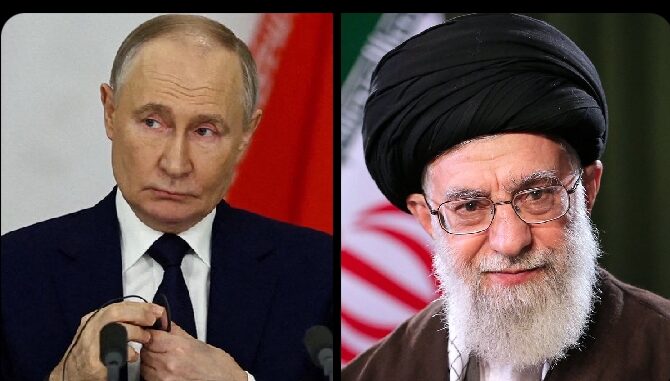
Images of Russian President Vladimir Putin alongside the late Khamenei circulated widely on social media following the Kremlin’s statement, framed as symbols of solidarity between Moscow and Tehran. The posts gained significant traction, with one widely shared version attracting approximately seventeen thousand likes and over two thousand six hundred reposts. The engagement reflected a global audience closely watching whether the crisis in the Middle East might intersect with Russia’s ongoing war in Ukraine, creating a wider and more dangerous geopolitical confrontation.
For Nigeria, the implications of this escalating standoff are both strategic and economic. As a major oil-producing nation, Nigeria is directly affected by any instability that reshapes global energy markets. The deepening alignment between Russia and Iran, two of the world’s most significant oil and gas producers, adds another layer of complexity to a market already under pressure from conflict-driven supply disruptions. Any expansion of hostilities that draws Russia closer to direct involvement could trigger price swings that affect Nigeria’s revenue, budget planning, and the cost of living for ordinary citizens.
Analysts at the Belfer Center have noted that Russia’s pattern in situations like this is to use condemnation as a tool for strategic leverage rather than a precursor to direct intervention. Moscow benefits from positioning itself as Iran’s most powerful ally without actually bearing the military cost of defending Tehran. The condemnation keeps Russia relevant in Middle Eastern affairs, strengthens its hand in negotiations on other fronts, and deepens a partnership that serves its interests in energy markets and arms trade without requiring it to fire a single shot….See More


Leave a Reply