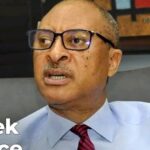
According to a report by Symfoni TV, on Sunday, January 11, 2026, the distinguished Nigerian management expert and political economist, Professor Pat Utomi, offered a critical assessment of the leadership hurdles currently hindering Nigeria’s progress.
During his analysis of the country’s trajectory, Utomi said, “One very important thing that I believe in is that whoever steps up to BAT in 2027 cannot be a superman.”
He emphasised that the notion of a single individual possessing the power to rectify every national grievance is an impractical expectation.
Reflecting on Nigeria’s democratic history, Utomi observed that deep-seated issues have persisted since the transition to civilian governance in 1999. He noted that many established politicians of that era remained sceptical about the military’s commitment to relinquishing control.
These figures adopted a cautious, observant stance because they suspected the transition was merely a strategic ruse by the armed forces.
This hesitation created a significant political void that was eventually occupied by individuals whose motivations did not align with the national interest. Utomi argues that the country continues to struggle with the consequences of that initial power vacuum.
The professor suggested that the nation has reached a point of stagnation and requires a fundamental “reset”. Characterising Nigeria’s current state as a dead end, he called for a renewed sense of national devotion and unified effort to foster reconstruction.
He pointed out that the solution lies in a leadership class capable of collaboration and mutual accountability, focused entirely on public service rather than the accumulation of personal wealth.
Utomi challenged the “hero” narrative of leadership, arguing that the historical reliance on a singular saviour has consistently failed the Nigerian people. Instead, he advocated for a model built on strategic planning, professional governance, and the strength of a collective team. He underscored that the primary purpose of holding political office should be sacrifice for the common good.
He remarked that, in most functional societies, those in public service are not driven by profit, suggesting that those seeking financial gain should pursue careers in the private sector instead.
Utomi urged the citizenry to prioritise the establishment of robust systems and durable institutions. He remains optimistic about the country’s vast underlying potential but maintains that real progress and widespread prosperity are only achievable through transparent, cooperative leadership and a commitment to institutional integrity.
If you love political news or like to get more news happening around the globe, use the button below to get more verified news happening around Nigeria and the world today.






Leave a Reply