A claim has emerged on social media that Iran has announced plans to cut undersea fiber optic cables in the Red Sea, Persian Gulf, and Mediterranean Sea, infrastructure that carries a substantial share of global internet traffic, international banking transactions, and financial communications.
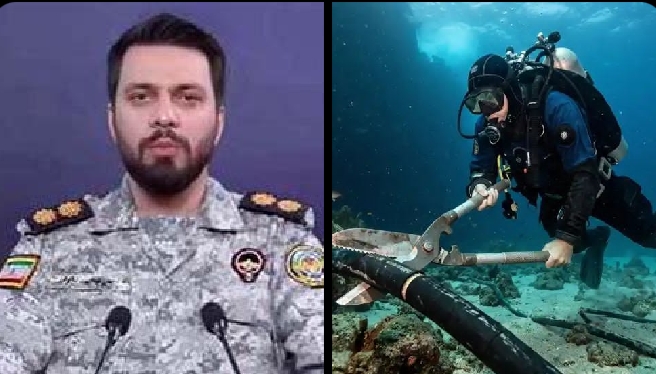
The post, shared by an account focused on politics and finance, included images of an Iranian military official at a podium and a diver severing a submarine cable, framing the threat as a deliberate strategic move to disrupt the digital backbone of the global economy.
Similar claims have circulated since March 2026 amid heightened US-Iran tensions, but verified official statements from Iranian authorities confirming such a plan have not been widely reported by major international outlets.
The threat, if real, would represent a dramatic escalation in the type of warfare Iran is willing to wage. Undersea fiber optic cables are the invisible infrastructure that makes the modern world function.
They carry more than ninety-five percent of international data traffic, including financial transactions, communication between stock exchanges, military and intelligence data flows, and the everyday internet usage of billions of people. The cables that run through the Red Sea, Persian Gulf, and Mediterranean connect Europe, Asia, Africa, and the Middle East, making them among the most strategically important communication arteries on the planet.
Cutting those cables would not just slow the internet. It would sever entire regions from the global digital network, triggering disruptions to banking systems, payment processors, supply chain coordination, and emergency communication networks.
The economic cost would be immediate and catastrophic, particularly for nations heavily reliant on digital trade and financial services. The psychological impact would be equally significant, signaling that no infrastructure, no matter how critical or how deep beneath the ocean, is safe from attack.
Undersea cables are vulnerable by design. They lie on the ocean floor, often in shallow waters near coastlines or straits, and are accessible to divers, submarines, and remotely operated vehicles. Deliberate sabotage of cables has occurred before, and accidents involving fishing trawlers and ship anchors regularly cause outages that take weeks to repair. Iran’s geographic position along the Persian Gulf and proximity to the Red Sea gives it access to multiple cable routes, and the technical capacity to locate and sever them is well within reach of a state-level actor.
Projects like Meta’s 2Africa Pearls submarine cable have faced delays and route changes due to security concerns in the Red Sea, highlighting the real and growing awareness that these cables are strategic targets in an era where digital infrastructure is as critical as oil pipelines or power grids. If Iran has genuinely threatened to cut cables, it would not be the first actor to recognise their value as leverage. What makes this claim significant is the scale and the timing, coming at a moment when Iran is already engaged in a multi-front conflict with the United States and its allies….See More








Leave a Reply