
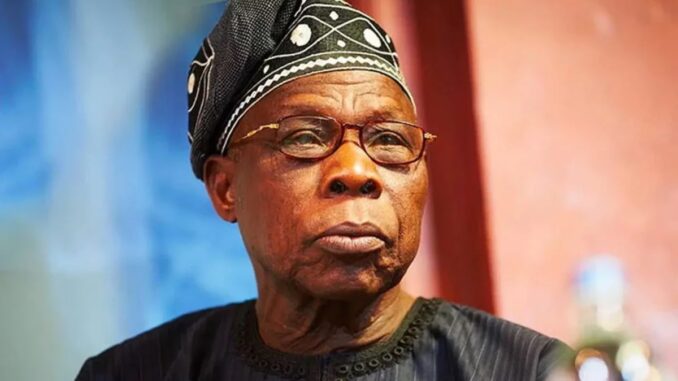
Former President Olusegun Obasanjo has stated that Nigeria has spent about $16 billion rehabilitating its state-owned refineries over the years with minimal results, contrasting it with Aliko Dangote’s roughly $22 billion investment to build Africa’s largest private refinery from the ground up.
The remarks, shared by the X account @NigeriaStories alongside a photo of Obasanjo, have reignited debate about management and efficiency in Nigeria’s oil sector.
Obasanjo reportedly argued that government-owned refineries are unlikely to function efficiently due to persistent mismanagement and structural challenges.
He suggested that repeated turnaround maintenance efforts have failed to deliver sustainable output despite significant public expenditure.
According to him, the contrast with the Dangote Refinery project demonstrates the effectiveness of private sector-led models.
Dangote’s refinery, located in Lekki, Lagos State, is widely described as the largest single-train refinery in Africa.
Built from scratch with an estimated cost of about $22 billion, the project is expected to significantly reduce Nigeria’s reliance on imported refined petroleum products.
Obasanjo cited it as an example of how focused leadership, accountability, and private capital can deliver large-scale infrastructure.
In his remarks, Obasanjo also referenced the Nigeria Liquefied Natural Gas (NLNG) project as another case where a public-private partnership model has produced measurable success.
The NLNG plant, developed with international partners and structured with commercial discipline, has been one of Nigeria’s more profitable and efficiently run energy ventures.
The comments have sparked strong reactions online. Many users expressed frustration over the reported $16 billion spent on refinery rehabilitation without consistent output, describing it as evidence of corruption and inefficiency in public spending. Some commenters argued that the recurring refinery failures symbolize broader governance challenges in Nigeria’s oil sector.
Others noted that while private investment has shown results, regulatory clarity and stable policy frameworks are also essential to sustaining growth. A few users cautioned against oversimplifying the comparison, pointing out differences in historical context, ownership structures, and operational mandates between public and private facilities.
Nigeria’s four state-owned refineries, located in Port Harcourt, Warri, and Kaduna, have struggled for decades with underperformance, frequent shutdowns, and maintenance issues.
Successive administrations have pledged reforms, including rehabilitation projects and partial privatization discussions, but consistent domestic refining capacity has remained limited until the emergence of private-sector alternatives….See More



Leave a Reply