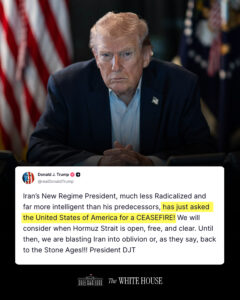
President Donald Trump has claimed that Iran’s new regime president has requested a ceasefire with the United States, describing the unnamed leader as less radicalised and more intelligent than his predecessors. The statement, shared through an official White House post, framed the alleged request as a sign that American military pressure is working. Trump conditioned any consideration of a ceasefire on the full reopening of the Strait of Hormuz to international shipping, a demand that ties any diplomatic progress directly to the restoration of global oil transit through the waterway.
In the same statement, Trump warned that until the Strait is secured, the United States would continue its military campaign with the explicit aim of blasting Iran back to the Stone Ages. The language was consistent with previous threats to target Iranian infrastructure including power plants, oil wells, and desalination facilities, threats that have drawn international alarm over their humanitarian implications.
Iran responded swiftly and unequivocally. Officials in Tehran denied that any ceasefire request had been made or that any contact with the Trump administration had taken place. More pointedly, they rejected the premise of the claim entirely, stating that no regime change has occurred in Iran. The reference to a new regime president, Iranian officials said, was baseless and bore no connection to reality on the ground.
The contradiction is stark and leaves the international community with two entirely incompatible narratives. Washington says a new and more reasonable Iranian leader has reached out for peace. Tehran says no such leader exists and no such outreach has happened. Both cannot be true, and neither side has offered verifiable evidence to settle the matter.
The Strait of Hormuz remains at the centre of the crisis regardless of which version is accurate. Roughly twenty percent of the world’s oil supply moves through the narrow waterway daily, and its disruption has already driven global oil prices up by an estimated fifty percent. The economic consequences have radiated outward to every corner of the global economy, with food prices, shipping costs, and energy bills climbing in countries far removed from the conflict itself.
For Nigeria, the implications remain immediate and personal. Higher crude oil prices offer a short-term revenue boost to the federal government, but the simultaneous increase in the cost of imported goods, refined fuel, and food staples erodes any benefit before it reaches ordinary households. Nigerians are already contending with inflation above thirty percent and a cost of living crisis that predates this conflict. Additional pressure from global commodity shocks lands on a population with very little capacity to absorb it.
Reactions to Trump’s statement were divided along familiar lines. Supporters interpreted the claim as proof of American dominance, arguing that sustained military pressure has forced Iran to seek terms. Critics questioned the credibility of a ceasefire claim that the other party flatly denies, warning that fabricating diplomatic progress to justify continued aggression is a dangerous path that has precedent in American military history.
The gap between what Washington is saying and what Tehran is confirming creates a space where miscalculation thrives. If Trump genuinely believes a new regime is reaching out and Iran insists no such regime exists, the two sides are not just disagreeing on terms. They are operating in different realities. Wars fought under those conditions do not end at negotiating tables. They escalate until the cost of continuing exceeds the cost of talking, and that threshold has not been reached…..See More




Leave a Reply