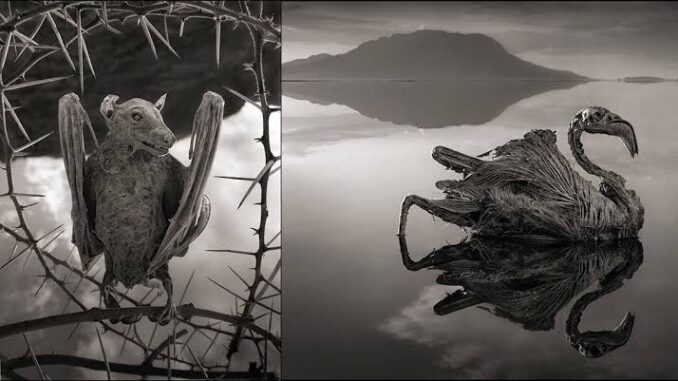
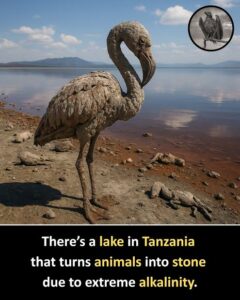
In the remote north of Tanzania, on the edge of the Great Rift Valley, lies a lake that has fueled myths for years. Photos from Lake Natron show birds and bats frozen in eerie poses along the shoreline, their bodies coated in white, their eyes glassy, as if they had been transformed into stone.
The images spread online and the lake earned a chilling reputation: the place where animals become statues. Now, after years of fieldwork and lab analysis, scientists say the mystery has an answer, and it is chemistry, not magic.
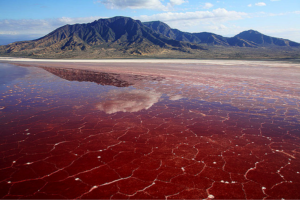
Lake Natron is unlike most lakes. It is shallow, extremely hot, and one of the most alkaline bodies of water on Earth. Its pH can climb as high as bleach, and surface temperatures often pass 60°C in the dry season. The water gets its caustic character from volcanic minerals that wash in from surrounding hills, especially sodium carbonate. When the sun beats down, water evaporates quickly and leaves those minerals behind as a hard, white crust called natron.
That is what gives the lake its “petrifying” effect. When a bird or bat dies in the water or is washed onto the salty shore, the alkaline liquid strips away soft tissue and begins coating what remains in mineral salts almost immediately. In the heat and wind, the process accelerates. Within days or weeks, the carcass can be encased in a brittle shell that preserves its shape with uncanny detail. To a photographer, it looks like stone. In reality, it is a mummified body locked inside a mineral cast.
The lake itself helps draw animals into danger. From a distance, Lake Natron can look like a calm freshwater mirror. Migratory birds flying at dawn or dusk sometimes mistake it for a safe place to land or skim for insects. Once they touch the highly reflective, caustic surface, their feathers can become waterlogged and their orientation fails. They struggle to lift off again. Bats that hunt low over the water face the same risk. Flamingos are the exception. They have adapted to the conditions and breed on the lake’s salty islands, where few predators can reach them. For most other species, a misjudged pass can be fatal.
Researchers who studied carcass sites and water chemistry across seasons found no evidence of instant fossilization.
True fossils take thousands or millions of years to form as minerals slowly replace bone. Lake Natron works much faster. It desiccates and encrusts. The result is preservation, not transformation. The animals are not alive when they harden. They are dead, then sealed by the lake’s salts before decay can erase their form.
The discovery settles the myth but raises new importance for the lake. Lake Natron is the primary breeding ground for more than three quarters of the world’s lesser flamingos. Its extreme conditions keep predators away and give the birds a rare safe haven. Understanding how the water chemistry works helps conservation teams protect both the flamingos and the fragile ecosystem that supports them. Scientists also value the lake as a natural laboratory for extreme environments, offering clues about how minerals preserve organic material in places that resemble early Earth or even other planets…See More







Leave a Reply