
Iran’s Islamic Revolutionary Guard Corps has issued a stark warning that any US crossing of what Tehran defines as red lines will trigger a response that extends beyond the Middle East, including potential strikes on American and allied energy infrastructure designed to disrupt global oil and gas supplies for years rather than weeks.
The statement, reported by BRICSinfo, comes after a series of Israeli and US-linked strikes on Iranian infrastructure including rail links, bridges, and critically, Kharg Island, the export terminal that handles ninety percent of Iran’s crude oil shipments.
The warning was delivered against the backdrop of President Trump’s latest deadline for Iran to reopen the Strait of Hormuz and his repeated public threats of severe and irreversible consequences if compliance is not achieved.
The IRGC’s statement is not vague. It is explicit. If the United States continues to escalate, Iran will retaliate not just within its borders or within the immediate region but globally, targeting the energy infrastructure that underpins economies across continents.
That could mean strikes on oil facilities in the Gulf, sabotage of pipelines in Europe or Central Asia, attacks on liquefied natural gas terminals, or disruption of shipping routes far beyond the Strait of Hormuz. The message is clear. Iran may be weaker than the United States in conventional military terms, but it has the reach, the capability, and the willingness to impose costs that are not containable to a single theatre of conflict.
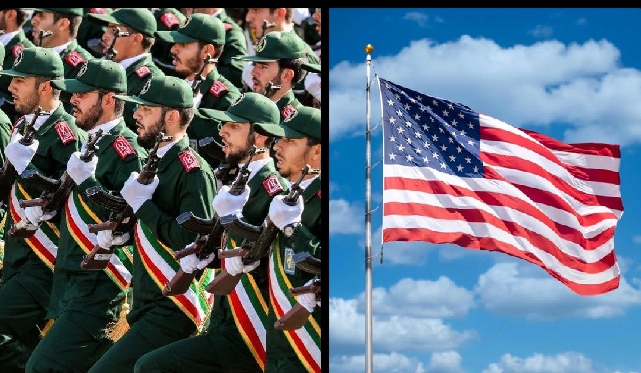
The images accompanying the post showed marching IRGC troops in formation and the waving American flag, a visual arrangement designed to emphasise the direct military standoff between two nations that are now openly threatening each other with actions that would have global consequences. The symbolism is intentional. This is not a proxy war. It is a confrontation between Iran and the United States, and the rest of the world is being told that it will not be insulated from the fallout.
The recent strikes on Kharg Island are particularly significant in this context. Kharg is not just another target. It is the artery through which Iran’s economic lifeblood flows. Damaging it is an attempt to cripple Iran’s ability to generate revenue from oil exports, and Iran views that as an existential threat. If the United States and Israel are willing to destroy Iran’s primary source of income, Iran is signaling that it will respond by threatening the primary sources of income for America’s allies and the global economy as a whole.
The warning about disrupting oil and gas supplies for years echoes an earlier statement attributed to Iranian officials and reinforces the asymmetry of the conflict. The United States can destroy Iranian infrastructure with precision strikes, but it cannot force Iran to rebuild that infrastructure or resume exports. Iran, in turn, cannot defeat the United States militarily, but it can impose costs that outlast any military campaign and reshape global energy markets in ways that no amount of American power can reverse.
Trump’s deadline and his threats of severe consequences have created a countdown environment where both sides are locked into positions that leave little room for retreat. If Trump does not follow through on his threats, his credibility collapses. If Iran does not respond to further escalation, it risks appearing weak to domestic and regional audiences. The result is a situation where both sides have strong incentives to escalate and weak incentives to back down, a dynamic that historically produces not negotiated settlements but widening wars….See More



Leave a Reply