
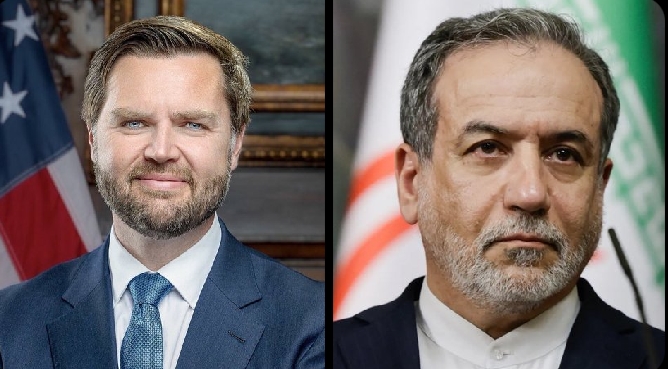
United States Vice President JD Vance conducted intensive overnight contacts with Iranian Foreign Minister Abbas Araghchi through Pakistani intermediaries, including Pakistan’s army chief General Asim Munir, amid active hostilities between Washington and Tehran. The backchannel diplomacy, reported by Reuters and shared by BRICSinfo, signals that even as both nations continue military operations and public threats, urgent crisis talks are taking place behind closed doors with Pakistan serving as the primary communication channel between two governments that have no formal diplomatic relations.
The post featured official portraits of Vance and Araghchi, placing the two figures side by side in a visual representation of a conversation that, until now, had been conducted entirely out of public view. The substance of the talks reportedly centred on ceasefire proposals, the reopening of the Strait of Hormuz to commercial shipping, and US demands for Iran to ease military pressure on American forces and regional partners. The fact that the talks went overnight suggests both urgency and difficulty, with negotiators working through complex positions under the pressure of a conflict that could spiral further at any moment.
Pakistan’s role as intermediary is not accidental. Islamabad maintains diplomatic and security ties with both Washington and Tehran, a position that gives it unique access and credibility as a neutral broker. General Asim Munir’s involvement underscores the seriousness with which Pakistan is treating the mediation effort and the trust both sides have placed in the Pakistani military as a secure and discreet communication channel. For Pakistan, successful mediation would elevate its regional standing and demonstrate that it can play a stabilising role in crises that threaten to engulf the wider Middle East and South Asia.
The timing is critical. The conflict has already produced downed fighter jets, rescue missions deep inside Iranian territory, threats to civilian infrastructure, and disruptions to global energy supply. Public statements from both sides have hardened rather than softened, with Trump issuing repeated ultimatums and Iranian officials dismissing American demands as unacceptable. The existence of backchannel talks does not mean either side is backing down publicly, but it does mean that both recognise the need for an off-ramp even if neither is willing to admit it in front of domestic or international audiences.
Iranian officials have publicly expressed zero trust in formal negotiations with the current US administration, and that scepticism extends to any framework that does not begin with American withdrawal from the region and compensation for damages. The fact that talks are happening at all suggests that Tehran, despite its public posture, understands that the military trajectory is unsustainable and that diplomatic engagement, however distasteful, may be the only way to prevent total destruction of its energy and civilian infrastructure.
For Vance, the talks represent a significant test of his role as vice president and his ability to manage crisis diplomacy under a president whose public statements often complicate rather than support negotiation efforts. If the backchannel produces results, Vance will gain credibility as a steady hand in a chaotic administration. If the talks fail and the conflict escalates further, the political cost will fall on him as much as on Trump…..See More

Leave a Reply