
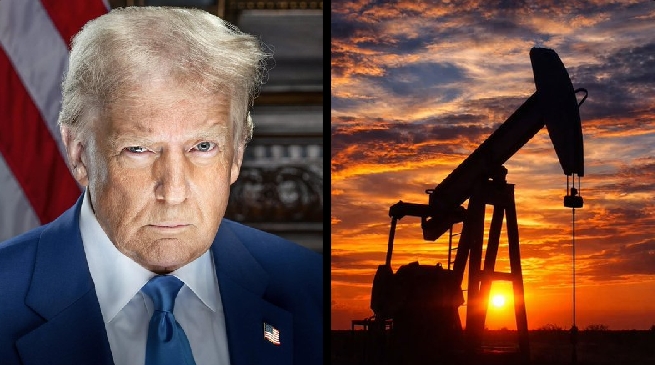
President Donald Trump has issued fresh threats to destroy Iran’s electric power plants, oil wells, Kharg Island export terminal, and potentially its desalination facilities if Tehran does not reach a deal with the United States and fully reopen the Strait of Hormuz to international shipping. The threats, delivered in late March and early April 2026 as part of the ongoing US-Iran conflict, represent some of the most explicit and wide-ranging targeting declarations Trump has made public, extending beyond military and energy infrastructure to include civilian water systems that millions of Iranians depend on for survival.
The statements, reported by BRICS News and accompanied by images of a stern-faced Trump and an oil pump jack, included references to seizing Iranian oil outright and imposed short compliance windows including a forty-eight-hour deadline and a specific date of April 6 by which Iran must act or face the consequences. The repeated issuance of ultimatums, each more detailed than the last, has created a pattern where Trump publicly telegraphs his targeting priorities while simultaneously setting deadlines that have so far passed without the promised military action being carried out.
Kharg Island is Iran’s primary oil export terminal, handling roughly ninety percent of the country’s crude shipments. Destroying it would cripple Iran’s ability to generate revenue from energy exports and send shockwaves through global oil markets already destabilised by the Strait of Hormuz disruptions. Targeting electric power plants would plunge Iranian cities into darkness, disabling hospitals, water treatment facilities, and communications infrastructure. Hitting desalination plants, which provide approximately seventy percent of Iran’s potable water according to World Bank data, would constitute an attack on civilian survival infrastructure and likely violate international humanitarian law.
The inclusion of desalination facilities in the threat is particularly alarming to human rights organisations and international legal experts. Water is a protected resource under the laws of armed conflict, and deliberately destroying the infrastructure that provides it to a civilian population of over ninety million people would create a humanitarian catastrophe that extends far beyond military objectives. Iran’s geography and climate make it heavily reliant on desalination, and any sustained disruption to those systems would force mass displacement, trigger disease outbreaks, and result in civilian deaths on a scale that no military gain could justify.
Trump’s reference to seizing Iranian oil suggests an intent not just to destroy infrastructure but to occupy and exploit it, a step that would require a ground presence far beyond anything the United States has deployed in the region so far. Seizing oil fields and export terminals is not an air campaign objective. It is an invasion objective, and the gap between what Trump is threatening and what the US military is currently positioned to accomplish raises questions about whether the statements reflect actual operational planning or rhetorical escalation designed to pressure Tehran into concessions.
The deadlines themselves have become less credible with each repetition. The forty-eight-hour window has come and gone multiple times. April 6 passed without the threatened destruction materialising. Each missed deadline weakens the perceived seriousness of the next one, turning what should be existential warnings into a cycle where the targets learn to wait out the clock rather than respond to the threat….See More


Leave a Reply