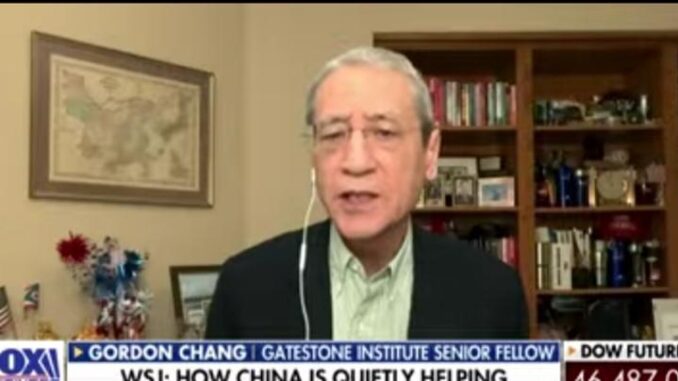
Gordon Chang, a senior fellow at the Gatestone Institute, has alleged that the missiles Iran used in a recent strike against the USS Abraham Lincoln aircraft carrier were supplied by China. Chang made the claim during an interview on Fox Business on Thursday, warning that Tehran possesses more of the same weapons and that the involvement of Chinese-made military hardware points to a level of cooperation between Beijing and Tehran that extends far beyond what has been publicly acknowledged.
The allegation, if accurate, carries enormous implications for the trajectory of the ongoing conflict between the United States and Iran. The USS Abraham Lincoln is one of the most powerful warships in the American fleet, and a successful strike against it using foreign-supplied advanced missiles would signal a significant shift in the nature of the threat Iran poses. It would also raise immediate questions about whether the United States is effectively fighting a two-front strategic challenge, one on the battlefield against Iran and another on the diplomatic and intelligence fronts against China.
Chang argued that the missiles in question were supersonic, a classification that places them among the most difficult weapons for modern naval defence systems to intercept. The speed and capability of such weapons suggest that Iran did not develop them independently, and Chang pointed directly at Beijing as the source. He maintained that China’s military relationship with Iran spans multiple areas and likely includes the transfer of critical weapons systems that enhance Tehran’s ability to challenge American forces in the region.
Chang was blunt in laying out his position during the interview.
“The supersonic missiles that Iran fired at the USS Abraham Lincoln, those are Chinese missiles,” Chang said.
He did not present detailed evidence during the broadcast to support the claim, but his remarks have added fuel to a debate that has been building since the conflict escalated. Western intelligence analysts have long tracked the military relationship between China and Iran, with particular focus on technology transfers, joint research programmes, and arms deals conducted outside the scrutiny of international sanctions. Chang’s comments bring that conversation into sharper public focus at a moment when the stakes could not be higher.
For Nigeria, the geopolitical significance of these developments is hard to ignore. The country’s economy remains heavily tied to global oil markets, and any expansion of the US-Iran conflict, particularly one that draws China into the equation, could trigger price volatility that directly affects government revenue and fiscal planning. Beyond economics, Nigeria maintains diplomatic relationships with all three nations involved, and a widening conflict would complicate the balancing act that African countries are increasingly being forced to perform between Western and Eastern powers….See More





Leave a Reply