
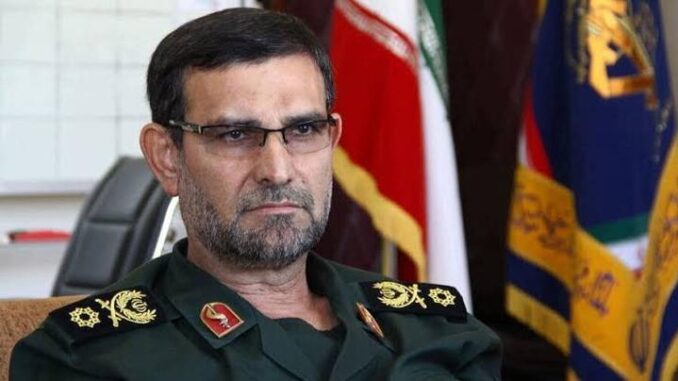
A senior commander of the Islamic Revolutionary Guard Corps Navy has issued a stern warning that any military strike on Iran’s Khark Island oil export terminal would trigger severe consequences for global energy markets, saying the world has already witnessed what Iran can do through its control of the Strait of Hormuz.
The warning was reported by Anadolu Agency on Monday, March 16, 2026, amid rising tensions in the Persian Gulf region and growing concerns over the security of critical energy infrastructure and supply routes.
According to the report, the IRGC naval chief said Iran has already proven its ability to influence global oil markets through its strategic actions in the Strait of Hormuz, one of the most important maritime energy corridors in the world. The narrow waterway handles a significant portion of the world’s daily oil shipments, meaning any disruption in the area directly affects international energy prices and supply chains.
The commander made it clear that further escalation against Iran would come at a heavy cost to global energy stability. “You already tested Iran once with the Strait of Hormuz,” the commander said. He went on to say that Iran’s management of the strait has already had a measurable impact on oil pricing worldwide. “If the smart control of the strait has drawn a new oil price benchmark for you,” he said, suggesting that Iran’s actions have already forced a shift in market expectations.
The commander then turned his attention to Khark Island, which serves as Iran’s principal crude oil export terminal located in the Persian Gulf. He warned that any attack on the facility would take the situation to an entirely different level. “Then an attack on Khark will create another severe and entirely new equation for the price and distribution of energy in the world,” he said.
Khark Island is considered one of the most strategically important energy facilities in the Middle East. The terminal handles the bulk of Iran’s crude oil exports and plays a central role in the country’s energy infrastructure. Energy analysts have long warned that any disruption at the facility, whether through military action or sabotage, could send shockwaves through international oil markets, driving prices sharply higher and creating supply shortages in key regions.
The Strait of Hormuz, which connects the Persian Gulf to the Gulf of Oman and the Arabian Sea, has been a flashpoint for regional tensions for decades. Roughly one fifth of the world’s oil passes through the narrow waterway daily, making it one of the most strategically sensitive chokepoints in global energy trade. Iran’s geographical position along the strait gives it significant leverage over maritime traffic in the area, a fact that Iranian military leaders have repeatedly referenced in their public statements.
The IRGC commander’s remarks come at a time of heightened military activity and diplomatic tension in the region, with multiple parties closely watching developments around the Persian Gulf. The warning reflects Iran’s strategy of using its control over key energy routes and infrastructure as a deterrent against potential military action.
International energy markets have remained sensitive to developments in the region, with oil prices reacting sharply to any signals of potential disruption. Analysts say the situation underscores the fragile balance between regional security dynamics and global energy stability, with any miscalculation carrying the risk of significant economic consequences worldwide.
As tensions continue to build, observers say the coming weeks will be critical in determining whether diplomatic channels can ease the situation or whether the region moves closer to a broader confrontation that could reshape global energy markets…See More
Source: Anadolu Agency.



Leave a Reply