

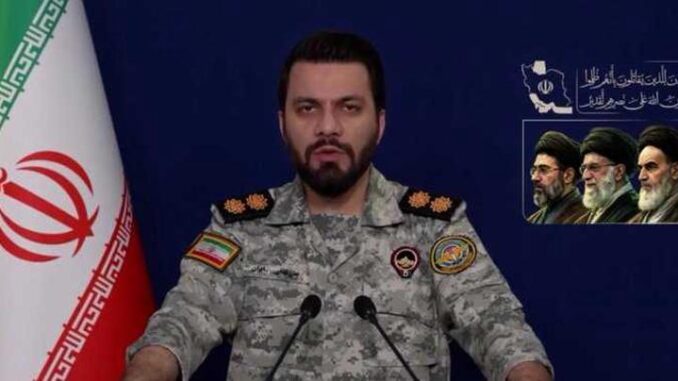
Iran has dismissed the impact of social media rhetoric on its ongoing military conflict with the United States and Israel, with a senior military spokesman telling US President Donald Trump directly that the outcome of the war cannot be determined by tweets and that only events on the battlefield will decide the result.
The statement was made on Tuesday by Brigadier General Ebrahim Zolfaghari, spokesman for Iran’s Khatam al-Anbiya Central Headquarters, according to a report by Anadolu Agency on Tuesday, March 17, 2026. Zolfaghari delivered his remarks in a video message that was broadcast by Al Jazeera, in which he addressed Trump directly and made it clear that Iran views the war as a military confrontation to be settled through combat, not through political messaging or online statements.
“The outcome of the war cannot be determined by tweets,” Zolfaghari said, in what appeared to be a pointed reference to Trump’s well-known use of social media platforms, particularly X, formerly known as Twitter, to comment on political and military developments. The Iranian commander stressed that the decisive factor in the conflict remains what is happening on the ground, not what is being posted online, and that military engagements will ultimately dictate the direction and result of the confrontation.
Zolfaghari did not stop at dismissing Trump’s social media activity. He also took direct aim at the name of the US military campaign against Iran, which has reportedly been dubbed “Epic Fury.” The Iranian spokesman ridiculed the title, suggesting that based on what he described as the reality of the situation, a more fitting name would be “Epic Fear.” The remark was clearly intended to portray the United States as acting out of anxiety and desperation rather than from a position of genuine military strength, a narrative that Iranian officials have pushed consistently since the conflict began.
The exchange reflects the broader information war that has been running alongside the actual military operations since hostilities escalated dramatically on February 28, when US and Israeli forces launched coordinated strikes on Iranian targets. That wave of attacks marked a major escalation in the conflict and set off a cycle of retaliation that has drawn in multiple countries across the region.
Since the initial strikes, Iranian authorities have claimed that approximately 1,300 people have been killed, including senior figures within the country’s political and military leadership. Among those reported killed is Supreme Leader Ali Khamenei, whose death in the early stages of the conflict was described by US and Israeli officials as a strategic blow to the Iranian command structure. Iran has not publicly confirmed or denied all of the casualty figures but has used the reported losses to rally domestic support and frame the conflict as an act of aggression against the Iranian people.
In response to the strikes, Iran has carried out a series of retaliatory operations involving both drones and ballistic missiles. These counterattacks have not been limited to Israel alone. Iranian forces have also targeted several neighbouring countries including Jordan, Iraq, and Gulf states that host US military installations. The strikes have caused casualties, damaged critical infrastructure, and significantly raised fears of a wider regional war that could pull in additional countries and destabilize the entire Middle East.
The war of words between Iranian and American officials has been almost as intense as the military operations themselves. Both sides have used media appearances, official statements, and social media platforms to shape public perception of the conflict. The United States and Israel have repeatedly claimed that Iran’s military capability has been severely degraded, pointing to the reduction in Iran’s daily missile output and the destruction of key oil infrastructure as evidence. Iran, on the other hand, has maintained that it is far from defeated and has framed its retaliatory strikes as proof that it remains a formidable military force capable of striking back across the region.
Zolfaghari’s comments on Tuesday represent the latest chapter in this ongoing battle for narrative control. By telling Trump that wars are not won through social media posts and by mocking the name of the US military operation, the Iranian spokesman appeared to be sending a message not only to the American president but also to domestic and international audiences that Iran intends to continue fighting and does not consider itself on the losing side of the conflict….See More
Source: Anadolu Agency




Leave a Reply