YIsrael has reportedly signaled that it will not carry out nuclear strikes on Iran, Gaza, Lebanon, or the Strait of Hormuz, citing the risk of massive casualties, widespread destruction, and the possibility of Iranian nuclear retaliation targeting Tel Aviv. The statement, shared in a breaking news post by an account focused on politics and finance, marks a rare public acknowledgment from Israeli officials of both the nuclear dimension of the conflict and the potential for catastrophic escalation if that threshold is crossed. The update was paired with a claim from Israeli experts that four hundred and fifty kilograms of Iran’s enriched uranium remains unaccounted for, raising fears that Tehran could rapidly assemble a nuclear weapon if it comes under nuclear attack.
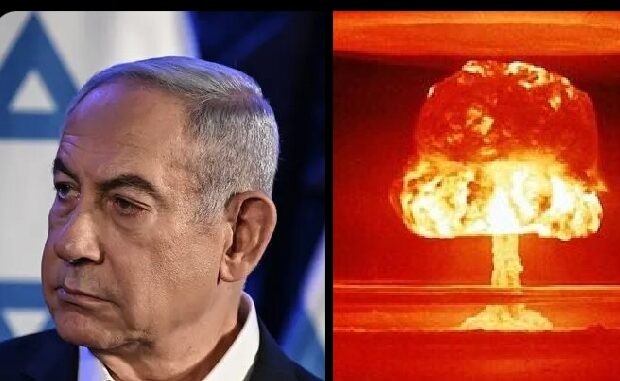
The image accompanying the post showed Israeli Prime Minister Benjamin Netanyahu alongside a stock photo of a nuclear explosion, a visual pairing designed to emphasise the gravity of the situation and the stakes involved. The framing was clear. Israel has nuclear weapons, Iran may be closer to having them than previously known, and the decision not to use them is driven not by morality alone but by the rational fear of mutual destruction.
Israel has never officially confirmed that it possesses nuclear weapons, maintaining a policy of strategic ambiguity that neither admits nor denies their existence. Estimates from international analysts place Israel’s arsenal at between eighty and four hundred warheads, making it the only nuclear-armed state in the Middle East. Iran, by contrast, has long insisted that its nuclear programme is for civilian energy purposes only, though Western intelligence agencies and the International Atomic Energy Agency have repeatedly raised concerns about military dimensions to the programme.
The claim that four hundred and fifty kilograms of enriched uranium is missing is significant if accurate. That quantity, if enriched to weapons-grade levels, would be sufficient to produce multiple nuclear devices. The fact that Israeli experts are publicly citing this figure suggests either that intelligence has confirmed the material’s diversion or that the claim is being used strategically to justify continued pressure on Iran and warn international actors that the nuclear threat is real and imminent.
The decision to rule out nuclear strikes on specific targets including Gaza, Lebanon, and the Strait of Hormuz reflects a calculation that the costs of such an action would outweigh any conceivable military benefit. A nuclear strike on Gaza or Lebanon, both areas with dense civilian populations, would constitute a war crime of historic scale and likely trigger international intervention that even the United States could not prevent. A strike on the Strait of Hormuz would irradiate a waterway that twenty percent of global oil passes through daily, rendering it unusable and triggering an environmental and economic catastrophe that would affect every nation on earth.
A nuclear strike on Iran itself, while militarily possible, would almost certainly provoke retaliation. If Tehran possesses or can quickly assemble even a rudimentary nuclear device, the Israeli calculation is that Tel Aviv, Haifa, or other population centres could be targeted in response. The risk of losing entire cities to retaliatory strikes makes first use not just morally indefensible but strategically suicidal….See More








Leave a Reply