

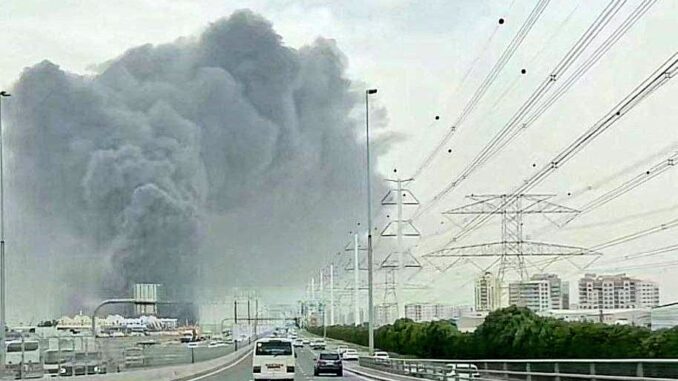
Iran has carried out a retaliatory strike on a Kuwaiti petrochemical plant in response to recent US and Israeli bombings of Iranian facilities, marking a dangerous expansion of the conflict beyond direct confrontation between Tehran and Washington into attacks on Gulf Arab states that host American forces or are perceived as enablers of the campaign against Iran.
The strike, confirmed by multiple credible sources including regional media and statements from Iran’s Revolutionary Guards, targeted Kuwait’s Shuwaikh oil complex along with nearby power and desalination plants. Images circulating online showed a massive plume of black smoke rising from industrial infrastructure near a highway, visible across large sections of Kuwait City.
The attack represents a calculated escalation by Iran. Rather than limiting retaliation to strikes on US or Israeli assets, Tehran has chosen to target the economic infrastructure of a neighbouring Gulf state, sending a message that any country that facilitates or supports the military campaign against Iran will pay a price.
Kuwait hosts American military personnel and has historically served as a logistical hub for US operations in the region, making it a target that Iran views as legitimate within the broader conflict even though Kuwait itself has not directly participated in strikes on Iranian territory.
The Revolutionary Guards claimed responsibility for the attack, stating that it was carried out in retaliation for the destruction of Iranian petrochemical facilities by US and Israeli forces. Iran’s petrochemical sector, which accounts for a significant portion of the country’s non-oil export revenue, has been hit repeatedly during Operation Epic Fury, with plants in Bandar Imam, Mahshahr, and Assaluyeh sustaining damage that has halted production and cost the Iranian economy billions of dollars. The strike on Kuwait is Tehran’s way of imposing symmetrical costs on the other side, targeting the same type of infrastructure that has been destroyed in Iran.
For Kuwait, the attack is both a security and economic disaster. The Shuwaikh complex is a critical component of the country’s energy and industrial sector, and damage to power and desalination plants threatens not just production but the basic functioning of a society heavily dependent on energy-intensive infrastructure in one of the hottest and most water-scarce regions on earth. The smoke plume captured in images suggests extensive damage, and the full scale of the impact on output, jobs, and regional stability may not be clear for days.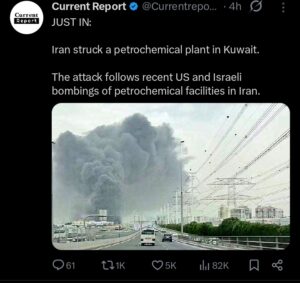
The broader implication is that Iran has moved beyond containing the conflict to its own territory and is now willing to strike across borders at targets in countries it deems complicit in the US-led campaign. That shift changes the calculus for every Gulf state. Saudi Arabia, the UAE, Bahrain, and Qatar all host American military installations and have varying degrees of economic and political alignment with Washington. If Kuwait can be hit, so can they, and the risk of becoming collateral damage in a war they are not directly fighting has just become immediate and tangible.
For global oil markets, the strike on Kuwaiti infrastructure is another shock to a system already stretched by the closure of the Strait of Hormuz and the disruption of Iranian production. Kuwait is one of the world’s top oil exporters, and any sustained damage to its energy facilities reduces global supply at a time when prices are already elevated and spare capacity is minimal. The market reaction will likely be swift, with crude prices climbing further and traders pricing in the risk that more Gulf infrastructure could be targeted in the coming days and weeks….. See More






Leave a Reply