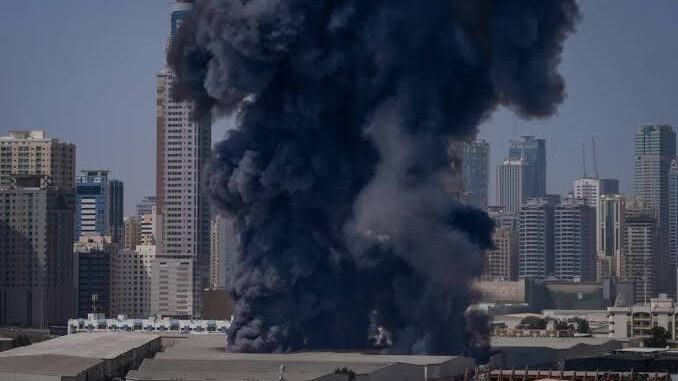
Iran launched seventeen ballistic missiles and thirty-five drones toward the United Arab Emirates on April 8, 2026, continuing a pattern of daily strikes on Gulf targets that has persisted since late February when the broader US-Iran conflict escalated following Israeli and American strikes on Iranian infrastructure.
The barrage occurred just hours after the announcement of a two-week ceasefire between the United States, Iran, and Israel, a truce that was supposed to pause hostilities and allow for the reopening of the Strait of Hormuz under Iranian military management. The ceasefire did not survive its first day.
UAE air defences were activated immediately, engaging the incoming projectiles in what has become a near-daily routine for the Emirates and other Gulf states. According to reports, the UAE has intercepted over five hundred and twenty ballistic missiles and thousands of drones since the conflict began, a figure that underscores both the scale of Iranian attacks and the effectiveness of the layered air defence systems the UAE has deployed with American and international support. Those systems include Patriot missile batteries, THAAD interceptors, and other platforms designed to detect, track, and destroy incoming threats before they reach population centres or critical infrastructure.
The strikes were not limited to the UAE. Kuwait and Bahrain also reported Iranian attacks on April 8, with Kuwait’s military describing an extensive wave of drone incursions and Bahrain activating its own air defences in response to incoming threats. The coordinated nature of the attacks across multiple Gulf states suggests that Iran’s retaliation was not a spontaneous response to a single incident but a planned operation designed to send a message that the ceasefire, from Tehran’s perspective, was void or never binding.
Iran’s justification for the strikes centres on the attack earlier the same day on the Lavan Island oil refinery, an offshore facility in the Persian Gulf that came under fire just hours after the ceasefire was announced. Iranian officials blamed unspecified enemies for the Lavan attack, and while no party has claimed responsibility, Tehran has framed the refinery strike as a violation of the truce that justified immediate retaliation. Whether the Lavan attack was carried out by the United States, Israel, the UAE, or another actor remains unconfirmed, but Iran’s response was to launch missiles and drones at multiple Gulf targets, effectively ending any hope that the ceasefire would hold….See More







Leave a Reply